Rolls-Royce and easyJet successfully test the first hydrogen engine
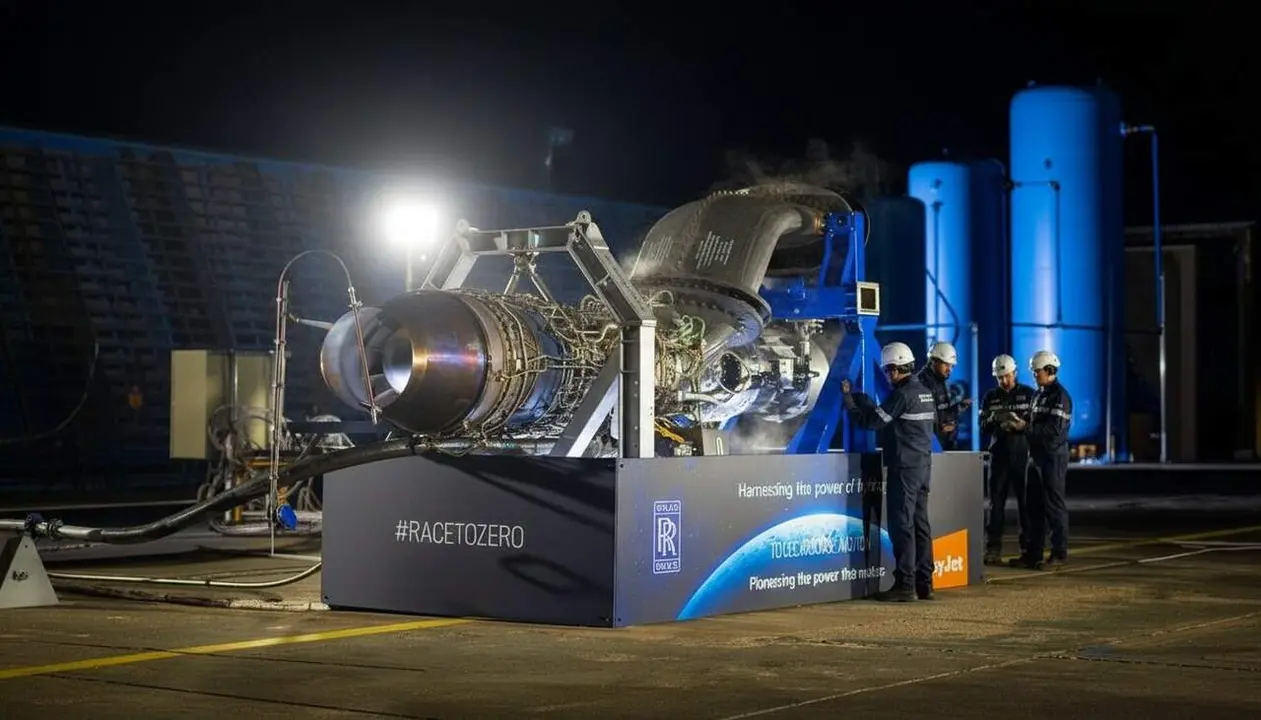

What happens when a brand that thinks it’s luxury starts playing with hydrogen? Rolls-Royce has tested an airplane engine that leaves gasoline behind and embraces hydrogen as fuel. And it’s no toy simulation, but a trial that marks a before and after for commercial aviation.
At NASA’s Stennis Space Center, this engine didn’t just start; it replayed everything that happens in a real flight: from takeoff to landing. With easyJet watching from the sidelines, the test made it clear that turbines can run on hydrogen without any apparent problems.
The hydrogen engine shaking up aviation
The project, which took four years to come to light, isn’t an idea that popped up all of a sudden. In 2022, a turbo-prop engine powered by green hydrogen was already tested at Boscombe Down, and now it’s the turn of Rolls-Royce’s Pearl 15, adapted to run entirely on this gas.
A trial under extreme conditions
The engineers pushed the engine to the limit: maximum power for takeoff, cruising, and landing, all with gaseous hydrogen. This confirms that existing technology can adapt to the new era of propulsion without pollutant emissions.
International collaboration and accumulated experience
The development has had the support of British scientists and experts from Tata Consultancy Services, who ensured the safety and viability of the system. This teamwork has made it possible to overcome essential technical challenges to advance toward more sustainable aviation.
The challenge of the future: storing hydrogen on board
Despite the success, a huge hurdle remains: how to store enough hydrogen on the plane without loading up on weight and space to impossible limits? The tanks needed are much larger than those for kerosene, complicating the design and autonomy of future aircraft.
Range and volume problems
Hydrogen occupies much more volume, making it difficult to maintain the same flight range with reasonable tanks. This is the engineering battle that Rolls-Royce and airlines will have to face in the coming years.
Infrastructure and logistics at airports
Additionally, the lack of a network of hydrogen refueling stations at airports is another major barrier. Without this, the massive implementation of this technology will remain on hold, even though the engine technology is already a reality.
Toward cleaner, nearer commercial planes
The results of these tests will be integrated into the development of engines for narrow-body airplanes, the most common on short- and medium-haul routes in Europe. This means that in a few years we could see commercial planes running solely on hydrogen.
EasyJet bets on innovation
The collaboration with easyJet marks a clear commitment to replace the traditional fleet with more sustainable and less polluting models, although the technology still has some hurdles to overcome.
The future of aviation, right now
As a Rolls-Royce spokesperson said in a 2026 interview, “this is a real step toward zero-emission air transport.” Still, the final word will belong to the engineers who solve the puzzle of storage and infrastructure.
The reality is that this trial isn’t just another experiment, but the confirmation that the future of commercial aviation can be sustainable and hydrogen-powered. The question is when we’ll be able to board a plane that stops smelling like kerosene and starts smelling like the future.