New durable and biocompatible coating for 3D bone implants
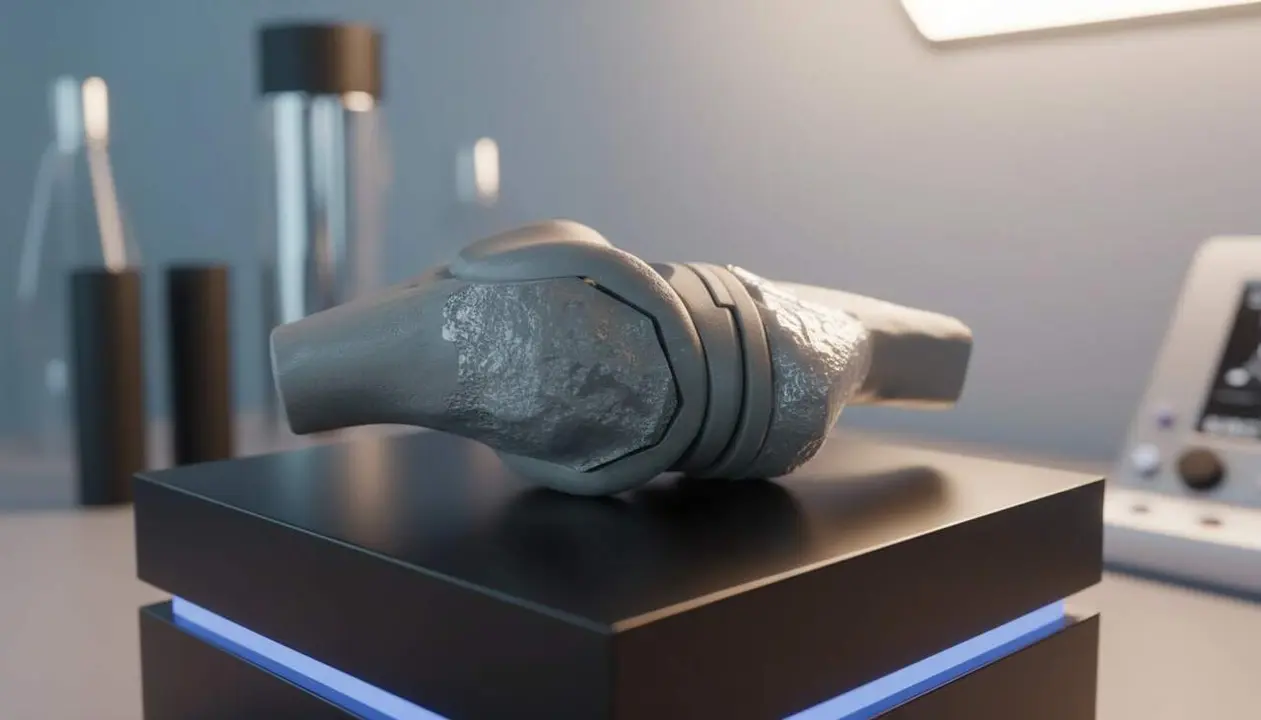

Imagine a bone implant that adapts almost like a natural bone. This is the reality that a scientific team from Seville has driven with an innovative coating that revolutionizes the compatibility and durability of 3D-printed implants.
The secret lies in an ultrathin layer that reduces corrosion and stiffness, improving interaction with bone tissue. This innovation promises to change the way bone prostheses are implanted and endure.
Characteristics of the new coating for bone implants
Composition and properties of the beta titanium alloy
The coating uses a beta titanium alloy that incorporates niobium, zirconium, and tantalum, elements that provide high corrosion resistance and superior biocompatibility. With a thickness of only 1-2 microns, this nanometric layer protects implants without adding weight or excessive stiffness.
This chemical formula facilitates the implant to transmit loads more naturally to the bone tissue, preventing mass loss and improving biomechanical integration.
Advanced deposition technique: HiPiMS plasma
The coating is applied using the HiPiMS technique, a variant of cathodic sputtering that uses high-intensity pulses to achieve a compact and nanostructured layer with a "rice grain" morphology.
This compact microstructure serves as an effective chemical barrier while improving the biomechanical compatibility between the biomaterial and the human body.
Collaboration and project development
Multidisciplinary consortium led by CSIC
The project has been possible thanks to the cooperation between CSIC, the University of Seville, the University of Valladolid, and the Polytechnic University of Catalonia. Since 2023, this team has combined knowledge to overcome the technological and biological challenges of 3D implants.
The scientific leadership of the TRIPS group at ICMS has been key in achieving a uniform coating on porous geometries such as scaffolds, essential for bone regeneration.
Phases and advances of the research
Initially, the HiPiMS technique was validated with titanium, aluminum, and vanadium alloys, widely used in biomedicine. Later, the application of the beta titanium coating on solid samples was perfected, achieving a 30% reduction in surface stiffness.
The qualitative leap has been to bring this technology to three-dimensional structures to improve force transmission and biological integration in real implants.
Implications and future projects
Benefits for implant durability and safety
The 81% reduction in corrosion current density and biomechanical improvement imply that these implants will be more resistant, less prone to failure, and better accepted by the body.
This may translate into fewer surgical revisions and a better quality of life for patients who need personalized bone prostheses.
Research perspectives and applications
The research group will continue applying the HiPiMS technique to implants with complex shapes and geometries, optimizing the functionality and durability of the materials.
The integration of 3D printing with advanced surface engineering opens the door to longer-lasting, safer prostheses tailored to individual needs.
| Aspect | Conventional coating | New beta titanium coating |
|---|---|---|
| Thickness | Variable, often thicker | 1-2 microns |
| Corrosion reduction | No coating | 81% less current density |
| Surface stiffness | High, can cause bone loss | 30% reduction, better force transmission |
| Biocompatibility | Standard | High, better tissue integration |
The reality is that this advance combines state-of-the-art materials with additive manufacturing to transform bone bioengineering.