Four Michelin innovations that will change military tires from today onwards
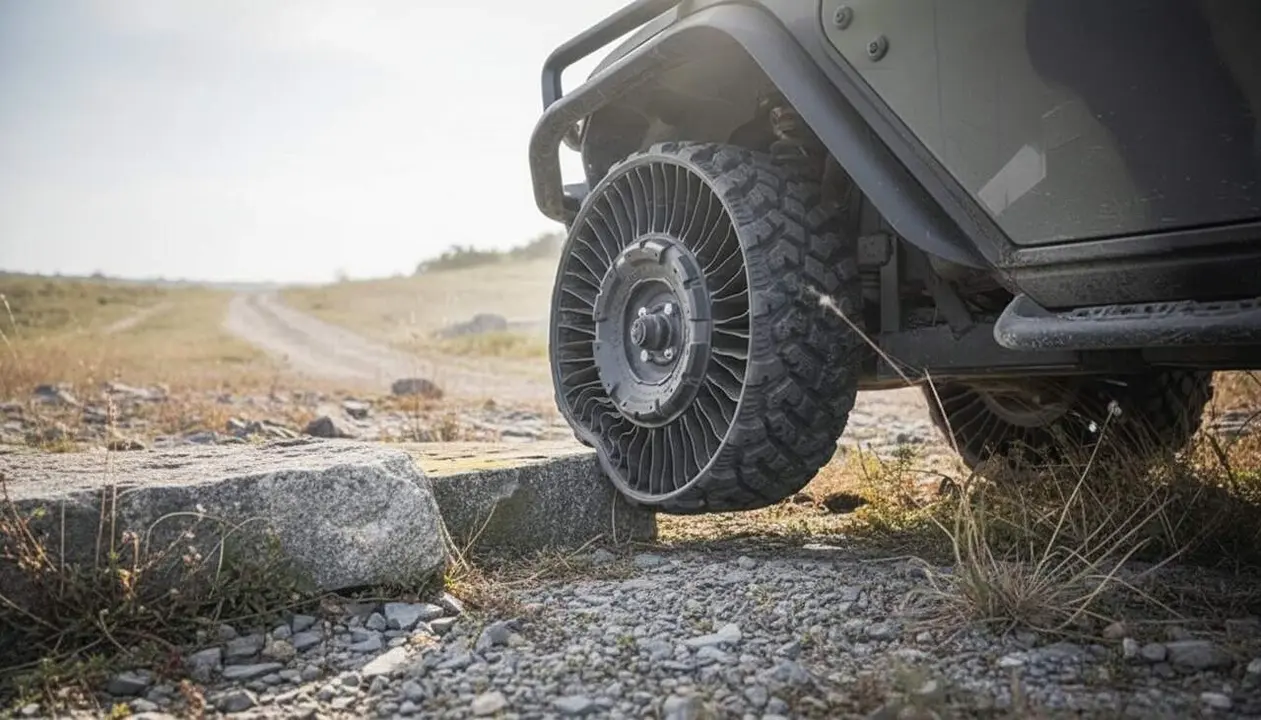

Michelin has created an airless tire capable of withstanding explosions and multiple bullet impacts without losing performance. This new technology transforms the military use of wheels and changes the game for light tactical vehicles.
If you have ever wondered how to overcome the fragility of traditional tires in combat, the answer lies in an innovative resin and steel structure that replaces air with a network of flexible spokes. But it’s not as simple as it seems.
The revolution of Michelin Tweel airless tires
Why does this innovation interest the reader who lives far from the battlefields? Because the Michelin Tweel is more than a wheel: it is the fusion between rim and tire, designed not to fail under extreme conditions. In combat, a stopped vehicle is a lost vehicle, and that marks the difference between life and death.
The Tweel eliminates pressurized air, replacing it with a framework of flexible polyurethane spokes and high-strength steel. This structure can absorb multiple bullet or shrapnel impacts and maintain the ability to roll without immediate repair. Traction improves because the tread adapts better to obstacles, unlike a traditional inflated tire.
Which vehicles already use the Tweel?
Military teams from the United States and South Korea have incorporated this technology into light tactical vehicles such as the Polaris MV850 and Polaris DAGOR, as well as robotic patrol vehicles. The U.S. Department of Defense has thoroughly evaluated this technology, confirming its reliability in real contexts.
Why don’t we see it on street cars?
As impressive as it is, the Tweel is not viable for high-speed passenger cars. The constant flexing of the spokes generates energy dissipation that raises the temperature enough to degrade the materials above 100 km/h, in addition to the noise and vibrations caused by its design.
Practical applications and limitations of the airless tire
What does it mean that this technology is limited to less than 20 tons? It means that, for now, it is only applied in light vehicles, especially in sectors where speed is not a priority but resistance is. This includes industrial, agricultural machinery, and light military vehicles.
The advantages are clearly visible in fields such as construction or landscaping, where mini loaders and tractors can operate without worrying about punctures or damage. In the military world, the Tweel offers a guarantee of mobility in hostile areas, maintaining the vehicle’s integrity against ambushes or explosions.
What are the main advantages?
- Resistance to multiple impacts without losing functionality.
- Guaranteed mobility even with damage to some spokes.
- Greater traction on difficult terrain thanks to the tread’s flexibility.
- Practically no maintenance, as it eliminates the need to inflate tires.
Where are the limitations?
- Maximum supported weight of about 20,000 kg, incompatible with heavy vehicles.
- Limitations at high speed due to heat and noise generation.
The future of airless tires in military and civil mobility
Is it now or never? Interest grows as manufacturers and armies verify the robustness of the Tweel. But the technology still must overcome technical challenges to reach passenger cars and larger trucks.
This matters because the automotive industry is looking for sustainable and safe alternatives. The Tweel shows that innovation can be disruptive, but also that the path to perfect mobility is full of technical details to resolve.
How will this affect the automotive industry?
Although for now the Tweel does not fit street cars, its application in specialized sectors sets a precedent. Michelin and other manufacturers like Hankook are working on variants that could reach broader markets, especially electric vehicles or those with specific resistance needs.
When will this type of tire become common?
It is difficult to specify an exact date. Military and industrial programs already use them, but for general use, technical and economic barriers remain to be overcome. Perhaps in a few years, we will see progressive expansion, especially in sectors where safety and minimal maintenance are key.
The reality is that this technology not only redraws the wheel concept but also opens the door to a new era in resilient and sustainable mobility. Michelin and its allies are already changing the game on the military field and beyond.
The mountains, combat zones, and construction sites will no longer be the same thanks to a wheel that literally does not stop before any obstacle or explosion.
Frequently Asked Questions
- What makes the Michelin Tweel tire so resistant?
- Its lattice structure of polyurethane and steel spokes replaces air, allowing it to withstand bullet and shrapnel impacts without losing rolling capacity.
- Why aren’t these tires used on street cars?
- The heat and noise generated at high speeds currently make them only viable for light vehicles with moderate speeds.
- On which vehicles is this technology currently applied?
- Mainly on light military vehicles, ATVs, UTVs, and industrial and agricultural machinery where resistance is a priority.