Germany revolutionizes construction with Europe’s largest 3D printed apartment building
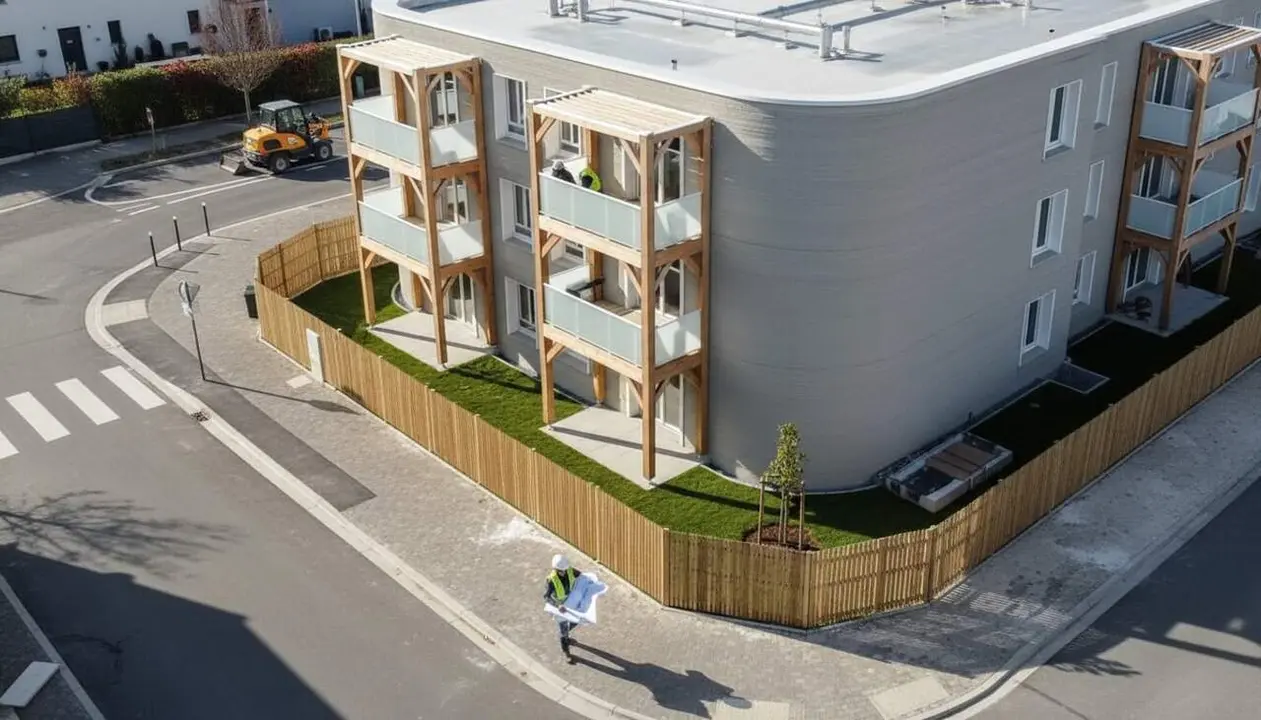

Germany has led a revolutionary leap in construction with the creation of the largest residential building in Europe printed with 3D technology. This pioneering project has demonstrated that building with 3D printing is faster and more efficient than traditional methods.
In the heart of the Champagne-Ardenne region, in France, only three workers built in 34 days a three-story building with twelve residences, a continental record that combines sustainability and innovation.
Why does this building matter for European construction?
The project shows the industry that 3D printing can radically transform the housing sector. Buildings no longer need months to be erected, nor depend on a large number of workers.
With a surface area of 800 m², it is proof that this technology can handle real-scale constructions while maintaining quality and structural strength.
How was the building constructed and what makes it unique?
The German company PERI 3D Construction used the BOD2 printer from COBOD, which prints a special cement mixture directly on site. This allowed the load-bearing structure and all walls to be built in just 34 working days.
This represents a saving of more than 15 days compared to the initial plan and much less time than conventional construction.
What sustainable features does the building have?
The building incorporates biologically and geologically sourced materials, a centralized heat pump system, and photovoltaic panels. This combination not only optimizes energy consumption but also provides great durability and fire protection.
3D printed concrete is not only strong but improves the overall safety and sustainability of the construction.
How does this innovation affect the future of the real estate sector?
The success of the French project shows that 3D printing can reduce time and costs in multi-family housing. For professionals and buyers, this means faster and more affordable buildings.
Furthermore, reducing labor needs and using more sustainable materials could change the entire construction industry.
What advantages does 3D printing have compared to traditional construction?
- Reduction in construction time by up to 40%.
- Decrease in material and labor costs.
- Lower environmental impact with the use of recyclable materials and less waste.
- Greater precision and structural quality.
What challenges remain to overcome in 3D printing of buildings?
Despite advances, technology still needs improvement for more complex structures and better integration of installed systems like electricity or water.
Likewise, sector regulations and norms must adapt to support these new ways of building.
What impact does this project have for France and Europe?
For France, this building is a turning point in modernizing its real estate stock, offering affordable and sustainable housing at a pace much higher than traditional methods.
At the European level, it sets a precedent that could trigger faster adoption of this technology, encouraging other countries to follow the German example.
How is this project perceived in the French real estate sector?
Professionals value the project as tangible proof that innovation can improve the response to housing demand and environmental challenges.
This technology is expected to grow among builders seeking fast and sustainable solutions.
What are PERI 3D Construction’s future prospects after this success?
The German company plans to expand and undertake more similar projects, betting on the evolution of 3D printing for residential and commercial buildings.
Its goal is to establish itself as the European leader in this emerging technology.
The reality is that this building represents much more than a record: it is a clear warning that construction will never be the same. 3D printers and new materials are changing the game, opening a future with faster, more economical, and sustainable housing.