3 keys of the Renault 5 E-Tech and Mobilize Power: how the car can return energy to the grid
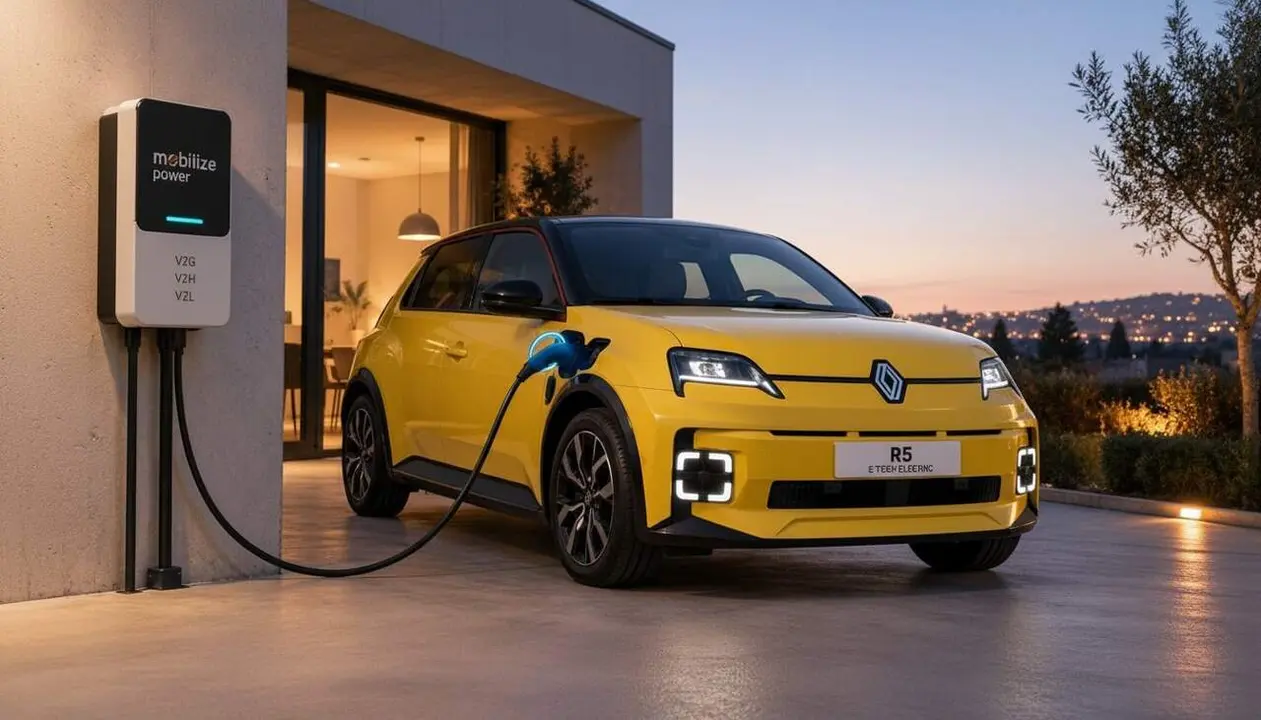

Yes: the Renault 5 E‑Tech with Mobilize Power can send electricity from the battery back to the grid when there is demand. This function is not just a socket to power a coffee maker: **Mobilize Power** allows multiple vehicles to form a small shared energy reserve and return it to the grid when needed.
The Renault 5 E‑Tech V2G technology requires specific components and contracts: a **bidirectional Powerbox**, a Mobilize contract managed by **The Mobility House**, and the **My Renault** app. This determines who can benefit from the functionality and where it is available.
What is the Renault 5 E‑Tech with Mobilize Power and Why Should You Care
For the owner, this can mean lower electricity costs and a new way to manage home energy. If you have a compatible Renault 5 E‑Tech, you don't just have an electric car: you have an asset that can serve as a shared energy reserve to reduce demand peaks and optimize consumption.
How does this affect the bill and daily convenience?
The concept can reduce costs if the vehicle is connected and you participate in the commercial service. However, savings depend on the vehicle's usage schedule, connection time, and the contract model offered by Mobilize. If you drive very little and leave the car connected, the impact may be greater.
How does the industry summarize this?
Corinne Frasson, head of energy services at Mobilize, summarized that vehicles become energy reserves. According to the French electricity operator **RTE**, vehicles are stationary **95% of the time**, and this reality is what makes the distributed reserve model viable.
How the Technology Works and What You Need to Use It
Bidirectional charging transforms charging into a reversible tool: the battery can receive and return energy. This happens through an inverter that converts the battery’s direct current into alternating current usable by the home or grid.
What do V2L, V2G, and V2H mean?
V2L allows using the vehicle’s socket as a household outlet for appliances; V2G returns energy to the grid; V2H can supply a home. Each mode has different practical uses and specific technical requirements.
What do you need installed to do this?
You need a compatible Renault 5 E‑Tech, a bidirectional Powerbox, and the Mobilize contract managed by The Mobility House. The **My Renault** app is also required for management. Not all charging points or vehicles are valid.
Real Impact, Limits, and Unknowns for the Owner
The global impact can be notable, but there are technical and commercial limits that affect savings. A single car has limited power; the real usefulness comes from the sum of hundreds of connected vehicles that, together, can cover demand peaks.
What real savings can an owner expect?
Renault indicates that with 11,400 km/year and leaving the vehicle connected about 14 hours a day, home recharging costs for the first year could be offset. This depends on the participation model and tariffs; it is not automatic for everyone.
Will the battery deteriorate faster?
Renault maintains an 8-year or 160,000 km warranty and argues that at 11 kW, usage density limits deterioration. However, concern is legitimate: continuous use for V2G introduces additional cycles, and the manufacturer’s warranty terms and monitoring must be followed.
Scientific and Grid Context
A study led by Fernando Aguilar Lopez and Dirk Lauinger (with the Norwegian University of Science and Technology and EPFL) estimates that this model could reduce raw material demand for batteries by 7.5% by 2050. This suggests a long-term impact on the need for new stationary storage.
Geographical Availability and Deployment
The commercial service has been operational since 2024 in France, and Renault announces new Powerbox installations from this September. For the Spanish market, Renault 5 offers V2L, but the commercial V2G service is not yet available in Spain.
A technical and social note. Viability depends on interoperability between the vehicle fleet, grid operators, and regulatory incentives. This is not a miracle solution, but a piece for better managing demand and infrastructure.
To summarize the key points: the Renault 5 E‑Tech with Mobilize Power can return energy to the grid through V2G; a **bidirectional Powerbox**, Mobilize contract, and the **My Renault** app are required; and owner savings depend on usage and the availability of the commercial service in their area.
The reality is that this technology transforms vehicles into energy assets, with potential to reduce consumption peaks and the need for new storage, but practical deployment is still conditioned by **technical requirements**, **business models**, and **geographical limitations**.
Frequently Asked Questions
- What does my Renault 5 E‑Tech need to participate in Mobilize Power?
- The vehicle must be compatible with the bidirectional function, a bidirectional Powerbox must be installed, a Mobilize contract managed by The Mobility House signed, and the My Renault app used.
- Can I use V2G in Spain with my Renault 5?
- Although the vehicle may have V2L, the commercial V2G service is officially operational in France; in Spain, the commercial service is not yet available.
- Will my battery lose capacity if I use V2G?
- Renault offers an 8-year or 160,000 km warranty and states that with charging at 11 kW, degradation is limited. Nevertheless, it is advisable to consult warranty terms and the manufacturer’s official monitoring.