No apps nor screens: Elon Musk reveals what will replace the mobile phone in just five years
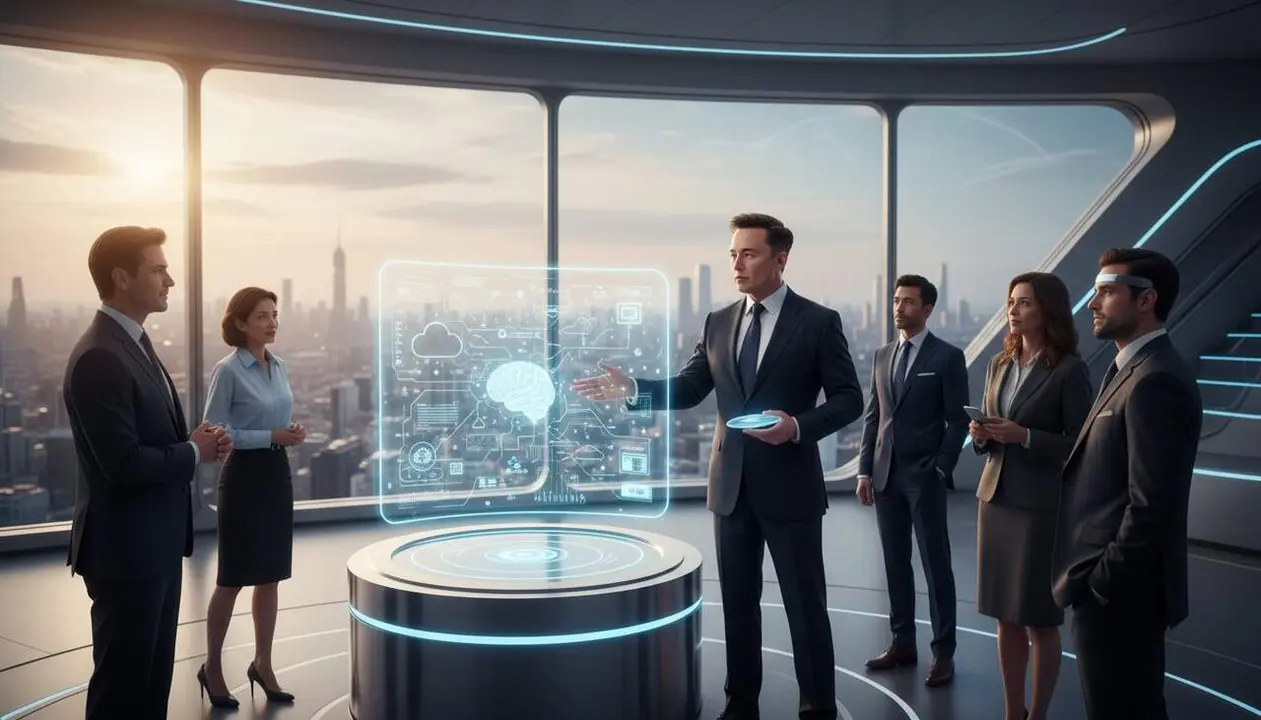

Direct answer: according to the interview cited in the source, Elon Musk predicts that phones will cease to be the main tool in five years and will be replaced by inference nodes connected to AI in the cloud. The original piece captures the view that the traditional model (screens with apps, menus, and operating systems) is fading in the face of systems that interpret and generate content in real time.
A brief anecdote: a user who asks an assistant for information and receives text, images, and video generated on the spot, without opening any specific application. *It sounds futuristic,* but this is the picture Musk painted in the mentioned conversation (and which we reproduce in the article).
According to the source text —which collects Musk’s statements on the Joe Rogan Experience podcast— the replacement proposal involves very simple wearable devices acting as inference nodes (devices that send data and receive responses from an AI model). This alternative eliminates the need for a traditional operating system like Android or iOS, because most processing is done on remote servers.
What Musk proposes and Why You Should Take It into Account
Why does this matter to the reader?
Because it will affect data privacy, dependence on cloud services, and how we pay for technology. If you have a mobile phone, a favorite app, or work in development, this changes the game.
What are the basic components of the proposal?
Simple model: wearable device (node), AI models hosted on high-capacity servers, and optionally brain-computer interfaces like Neuralink. The node captures inputs (voice, gestures, signals) and sends the request to the model, which returns multimodal content (text, image, video, sound).
How it will affect users, manufacturers, and developers
How will this affect the average user?
The user might stop installing applications and switch to interacting with a single conversational agent that generates services on demand. This simplifies the experience but concentrates logic and data in model providers.
What consequences does it have for manufacturers and app stores?
App stores could lose relevance if tools are offered as model capabilities instead of standalone applications. This forces manufacturers to rethink the device’s differential value (optimization for AI, hardware acceleration, local security).
How to check if this change could affect you and How to prepare
How do I check if I am vulnerable to this transition?
Check your cloud dependence and how many critical services use remote processing; if you rely on applications that already work with AI assistants or generative services, you are more sensitive to the change.
What practical measures can you start taking now?
Make backups, review app permissions, and consider strong authentication options. It is also worth following the evolution of BCI technologies if you work in health or accessibility.
Step by step to check your exposure
- Open Settings > Privacy > App Permissions and review which apps send data to the cloud.
- Go to Settings > Account or Security and enable two-factor authentication (2FA) if available.
- If you have an Android or iOS device, review backup and data encryption options (to reduce third-party dependence).
How is the replacement explained technically? The key idea is to separate the interface (simple device) from processing (models on remote servers). This is based on inference nodes: lightweight equipment that collects inputs and shows results, while inference (AI response calculation) occurs in hardware accelerators at data centers.
But the source does not detail exact protocols, encryption levels, or which providers would control these models. This absence requires caution about risks of concentration and privacy.
Verification checklist
- Have you used generative assistants to replace apps? — Yes → High exposure.
- Do you depend on devices with much local processing (offline video/photo editing)? — Yes → Lower exposure.
- Do you use 2FA and local encryption? — Yes → Reduced risk.
- Are you in sensitive sectors (health, finance)? — Yes → Requires auditing.
| Platform / Version | Affected | Solution details |
|---|---|---|
| Android | Mentioned | Not specified in the source (depends on providers). |
| iOS | Mentioned | Not specified in the source (depends on Apple). |
| BCI Interfaces (Neuralink) | Possibly relevant | The source collects prior clinical trials but no massive deployment timeline. |
An expert interpretation: this announcement makes sense as a technological future vision —concentration of intelligence and multimodal generation— but viability depends on server infrastructure, governments, and business models. If you are a developer, start thinking of services as capabilities instead of applications; if you are a user, protect data and amplify security controls.
Prevention and maintenance: update systems, enable 2FA, review app permissions, and maintain encrypted backups. Watch the release of AI products and protocols, and consider local autonomy solutions for sensitive data.
Warning sign: sudden increase in personal data requirements, urgent access offers to models without privacy guarantees, or devices pushing for permanent cloud connections. If you detect this and handle sensitive data, consult a security expert or a data protection lawyer.
Final reflection: Elon Musk’s prediction opens a debate about the future of the human-computer interface and who will control AI capabilities. **Smartphones**, **inference nodes**, and **Neuralink** are the key words that define this scenario; prepare yourself with security and awareness, because the change will affect technology, privacy, and the economy.
Frequently Asked Questions
- What does it mean that phones will become obsolete?
- It means that most interaction and processing could move to remote AI models, while devices would function as lightweight terminals.
- When could this transition begin?
- The source talks about a horizon of about five years according to Elon Musk, but offers no concrete timelines or details of massive implementation.
- How do I protect my data if this happens?
- Enable 2FA, use local encryption when possible, review app permissions, and avoid sending sensitive data to services without verifiable guarantees.