Tesla Cybertruck on the lake: Elon Musk's promise that ended badly
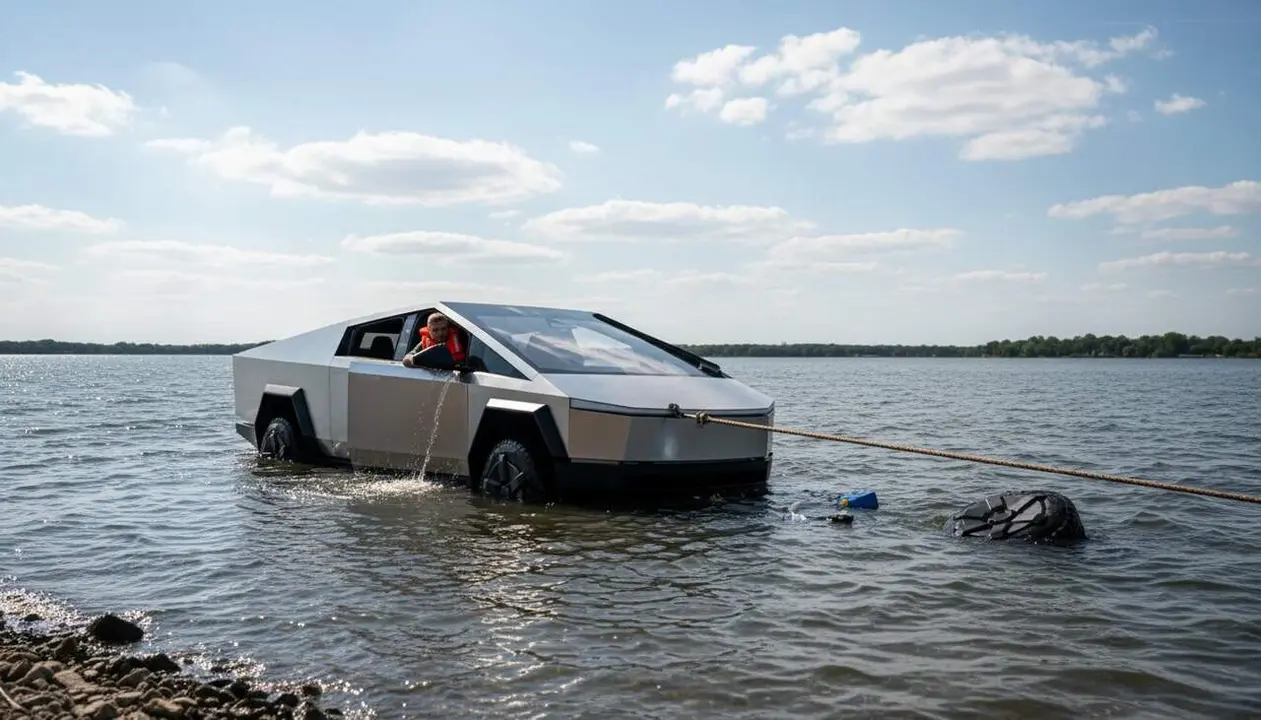

Imagine wanting to show that your electric car is capable of everything and ending up with a derailment mid-water. That’s exactly what happened with the Tesla Cybertruck at Grapevine Lake: a demonstration that ended more like a disaster than a feat.
The Cybertruck, that pick-up Elon Musk promised could cross rivers and calm seas, got stuck while trying to test its famous "Wade Mode." And no, it wasn’t a movie scene, but a real showcase of what not to do with a large electric car.
Elon Musk's promise and the reality of the Cybertruck
When Musk launched the idea that the Cybertruck could act as a boat for short periods, everyone was amazed. But the technical reality is quite different: the vehicle has neither propellers, nor a hull to float, nor a weight to help navigate. Simply, its ability to wade waters does not make it a real vessel.
Wade mode: what it is and what it isn’t
The Cybertruck’s "Wade Mode" is designed to assist in flooded areas or controlled water crossings, not for impromptu maritime rides. The Tesla can handle small aquatic obstacles, but hopes of crossing a lake are, at best, excessive.
The line between innovation and recklessness
The driver who wanted to see how far he could go ended with the vehicle stuck and the intervention of the Grapevine Police. The result? Detention and vehicle abandoned in the water. A wake-up call reminding that advanced features are not an invitation to risk your life.
Public reaction and controversy on social media
When the police shared the case on Twitter, the response was immediate and divided. Some saw the loss of the Tesla as a fair punishment; others questioned whether the detention was necessary. The debate highlighted how Musk’s words can make people interpret a technological promise literally, with costly consequences.
The influence of Elon Musk’s statements
The claims about the Cybertruck’s capabilities have fueled expectations that don’t match technical reality. This creates a gap between what is expected and what the vehicle can do, especially in extreme situations.
Social media as the Cybertruck’s court
Users debated with irony and criticism, pointing out that a car that "drinks like an SUV but thinks it’s sporty" shouldn’t try to prove it can act as a boat. The Cybertruck has gone from a symbol of innovation to an example of how not to interpret the functions of electric vehicles.
Lessons for drivers and the Cybertruck’s future
The case makes it clear that a car, even if electric and technological, should not be a reason to take more risks than necessary. Features like wade mode are useful, but they are not a passport to do whatever you feel like.
Tips for using wade mode wisely
- Use it only in shallow and controlled water areas.
- Do not exceed the manufacturer’s recommendations regarding depth.
- Avoid situations where the vehicle could get stuck or unsupported.
The Cybertruck’s future and reputation after the disaster
Despite the controversy, Tesla continues to bet on this model. But this incident reminds us that, no matter how much Musk sells revolutionary promises, physics and technology have their limits. And crossing a lake is not the same as crossing a deep puddle.
This episode of the Tesla Cybertruck at Grapevine Lake puts on the table that technological features do not replace common sense. A vehicle stuck, a detention, and a lot of discussions, all because the line between fiction and reality got too blurred.