The Rovira i Virgili University digitally reconstructs Gaudí’s lost loudspeaker at the Cathedral of Mallorca
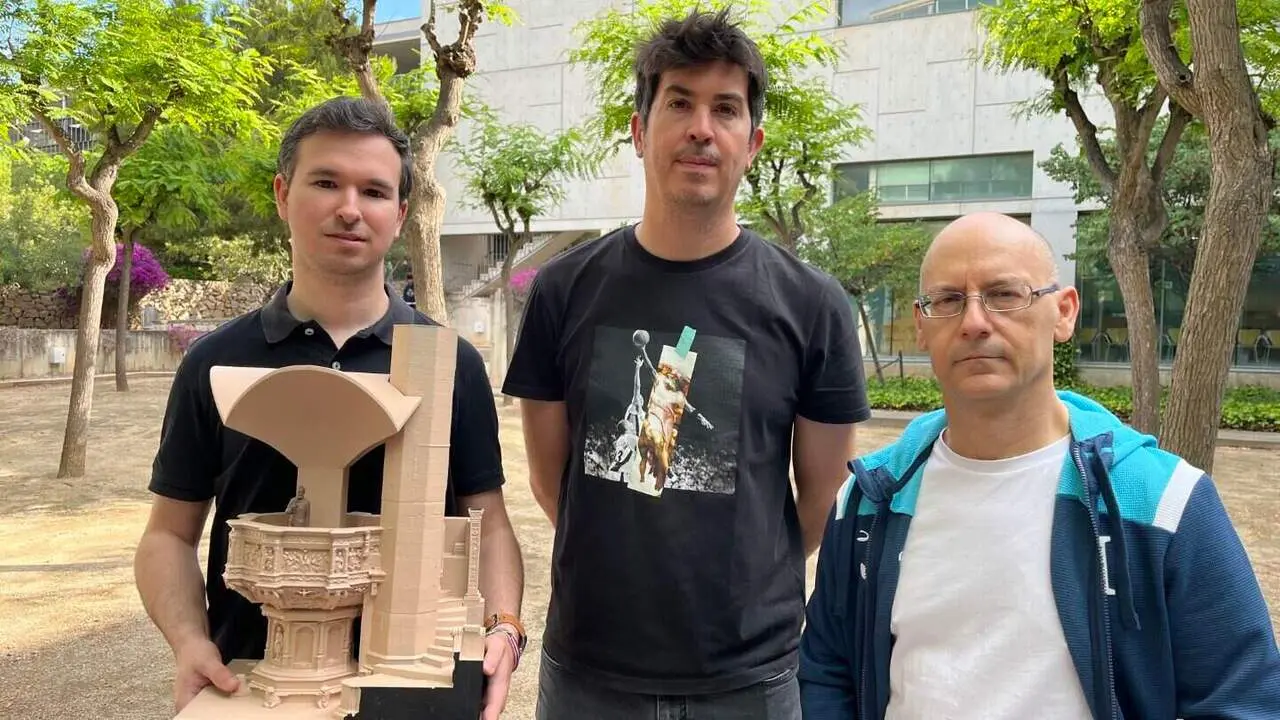

A team from the Universitat Rovira i Virgili has digitally recreated the sounding board that Antoni Gaudí designed for the main pulpit of the Cathedral of Mallorca, an element that disappeared in 1970 and is considered key to the temple’s acoustics. The reconstruction, based on a combination of old photographs and 3D modeling technology, allows the recovery of an essential fragment of Majorcan architectural heritage.
This project transcends a simple image: it opens the door to an interactive experience and expanded knowledge of a work that was only preserved in memories and partial drawings.
The history and function of Gaudí’s sounding board in Mallorca
What was the sounding board and why did it disappear?
The sounding board was part of a commission by Bishop Pere Joan Campins to Gaudí in 1901 to improve various liturgical elements of the Cathedral of Mallorca. This device, made of wood and fabric, adapted to the octagonal geometry of the pulpit and was topped by three parabolic surfaces that directed and amplified the speaker’s voice.
Despite being declared a Historic Monument and receiving the attention of architects like Le Corbusier, the sounding board disappeared in November 1970 when part of the work was demolished, leaving a notable void in Gaudí’s legacy in Mallorca.
How was this element conceived within the restoration project?
Gaudí not only designed shapes; he thought about sound. This sounding board was integrated into a project that included moving the choir to the Royal Chapel and creating a harmonic box under the presbytery. With collaborators like Joan Rubió and Josep Maria Jujol, Gaudí sought for the architecture to enhance the acoustic experience.
The sounding board, therefore, was not just decorative but a functional element that improved the projection of the word within the temple, taking advantage of the acoustic properties of the parabolic shapes.
The technique and process of digital reconstruction
How was the structure recreated without original plans?
Without plans or precise geometric documentation, the research team combined analytical and descriptive geometry with advanced technology. They scanned the cathedral and the main pulpit with more than 1,250 laser scans, generating a point cloud with 21 million data points, achieving a 3D model of the pulpit with 95% accuracy.
From ten historic photographs, they selected five images with rigorous criteria, using two geometric methods to calculate the position from which each photo was taken, with differences of less than one meter. This allowed reconstructing the parabolic curves that defined the shape of the sounding board.
What methodology was applied to adjust the final shape?
The process included generating provisional three-dimensional models based on the analysis of curves visible in the photographs. With geometric calculations, they identified the parabolic shape that best fit each surface of the sounding board.
This culminated in the creation of a digital model that not only represents the structure but can be reused in research or digital manufacturing, thus preserving this heritage for future generations.
Acoustic research and innovation in architectural heritage
How did the sounding board function according to acoustic calculations?
The parabolic surfaces of the sounding board allowed concentrating and directing sound towards a specific area in front of the pulpit, improving voice projection. The URV team calculated the optimal position for the speaker, confirming that Gaudí’s design had a very precise and effective acoustic purpose.
This discovery reveals Gaudí’s technical sophistication, combining form and function in a work that still amazes today.
What impact does this methodology have on heritage recovery?
Beyond the sounding board, the applied methodology allows transforming incomplete historical information into contrastable and verifiable architectural models. This opens new paths to recover disappeared elements and understand the formal logic of historic works only partially documented.
The digital model is available to the research community and can serve as a basis for teaching, research, or even physical reproduction, an important step to preserve and disseminate heritage.
In short, this Catalan university’s work not only returns a lost piece but also provides a new way to understand and conserve architectural history.
The combination of digital technology and scientific rigor has made it possible to recover a key element designed by Gaudí and, at the same time, demonstrate that the future of heritage conservation lies in these innovative techniques.
Source of the article: Universitat Rovira i Virgili