Nokia 300 Charge: the phone that lasts weeks and also charges other devices
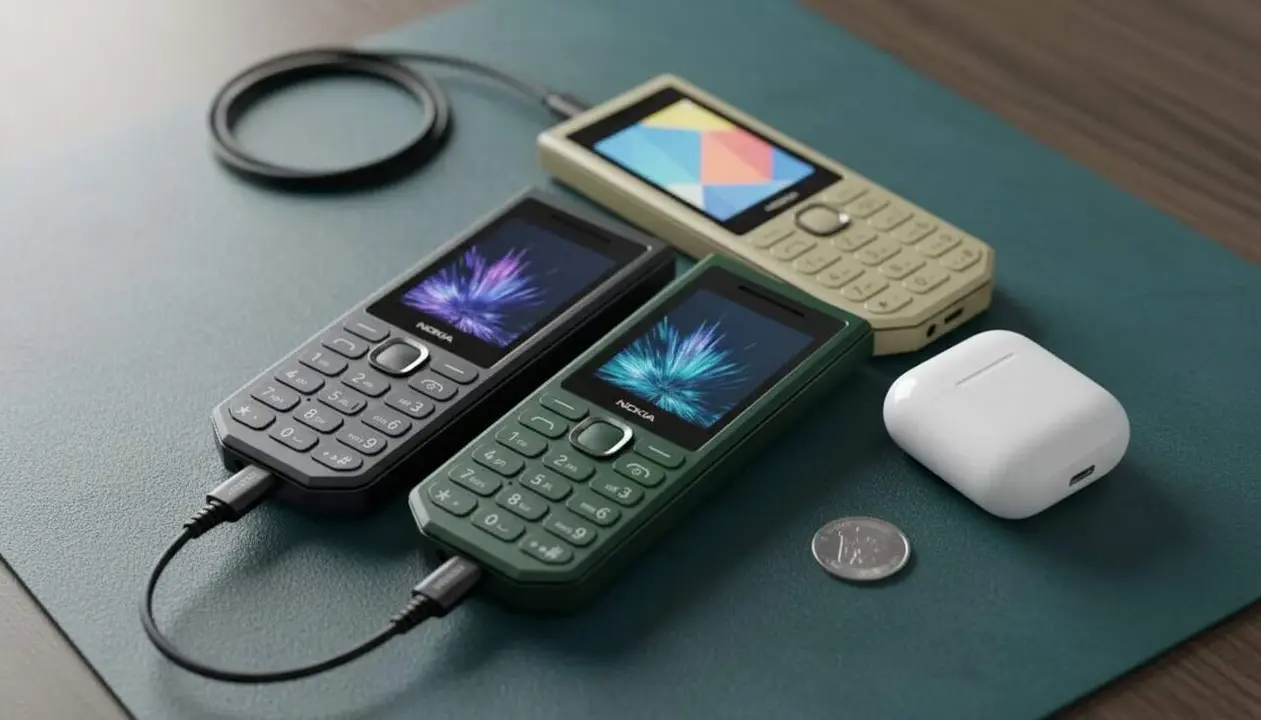

Direct answer: the Nokia 300 Charge is a basic phone with a 3,700 mAh battery that, according to HMD and Redacció Clarín's coverage, supports long autonomy and can supply up to 10 W via USB-C. The story starts with an anecdote: many remember the Nokia 1100 as the example of durability and simplicity; the 300 Charge takes that logic and adapts it to current technology (a touch of nostalgia that works).
Source: Redacció Clarín. Nokia 300 Charge, according to the specifications published by HMD and collected by the source, focuses on basic tasks —calls, SMS— but with a battery that, they promise, can last weeks on standby and serve as a power reserve for other devices.
What it is and Why it matters
Why should it matter to you? If you spend long days away from the plug or seek to reduce time on social networks, this phone offers a practical solution: more autonomy and a charging output for small devices.
How does it differ from the Nokia 1100?
Short answer: it retains the 1100’s philosophy of autonomy and simplicity but incorporates ports and components of the modern era (USB-C, more powerful LED lights).
The 1100 was remembered for its simplicity and resistance. The 300 Charge recycles that formula —compact design and basic functions— and adds modern autonomy (3,700 mAh) and the ability to deliver power via USB-C. It is, in short, a reinterpretation: same spirit, current components.
What specifications does it include?
Short answer: 3,700 mAh battery, up to 37.9 hours of talk time and more than 40 days standby; USB-C output up to 10 W; 2.4" QVGA display; physical keyboard; S30+ system.
Detailing from the source: 3,700 mAh battery; official autonomy stated as up to 37.9 hours of talk time and more than 40 days standby; output to charge other devices via USB-C with a maximum input/output power of 10 watts; high-power LED light (HMD claims up to four times the intensity of the Nokia 105, according to internal tests). 2.4-inch screen with QVGA resolution, physical keyboard, Unisoc SC6531E processor, 4 MB of RAM and 4 MB of internal storage (expandable with microSD up to 32 GB), 3.5 mm headphone jack and S30+ system oriented to basic functions.
Who cares and How it can improve usage
Why is this relevant for the reader? If you need a second phone, travel with little electrification or want to reduce dependence on smartphones, the proposal offers real benefits: fewer charges, more peace of mind, and an extra function as a power reserve.
Who really benefits?
Short answer: nostalgic users, people who make long routes without access to power, and those who want a secondary device for calls and messages.
It particularly benefits those who prioritize autonomy and simplicity: professionals working in the field or travelers, users needing a resistant phone, and families wanting a device for emergencies or for children. Unlike a smartphone, here the battery is the core of the proposal.
What practical scenarios does it solve?
It acts as the main phone when charging is scarce; serves as a reserve to charge earbuds, a second phone, or other small accessories when needed; and the LED light extends its use in low-visibility situations. It is a combination of practical tools rather than an entertainment center.
How to test and use the charging function (what we know)
What should you know before trying it? The source confirms the capacity to deliver power via USB-C (up to 10 W), but does not specify the exact procedure to activate this output; therefore, any specific enabling step cannot be stated with certainty.
How to activate charging other devices?
Short answer: the source does not provide activation instructions; it only states that the phone can deliver power through USB-C (10 W). There are no details about menus or buttons.
Clear limitation: Redacció Clarín collects HMD specifications but does not describe whether the function is automatic upon connecting the cable or if it must be activated from a menu. For that reason, we cannot invent steps the source does not indicate.
Suggested procedure (based only on what the source confirms)
- Check that the device shows the name Nokia 300 Charge on the box or documentation (this confirms the model).
- Locate the USB-C port and the compatible USB-C cable (the source indicates output is via USB-C).
- Connect the USB-C cable between the Nokia 300 Charge and the device to charge; observe if the receiving device indicates charging (the source states it can supply up to 10 W).
- If there is no charging, consult official HMD documentation (the source does not detail activation menus or steps).
Note: these instructions are strictly based on publicly mentioned information by the source; HMD has not yet published complete usage instructions according to the coverage.
Checklist to verify if your phone has the function
- Model label on the box or manual: "Nokia 300 Charge".
- 3,700 mAh battery indicated in the official specifications.
- Physical USB-C port on the phone (present according to the source).
- Charging indication on the receiving device when connected (empirical observation).
- If any of these elements are missing, the function indicated by the source is not confirmed in your unit.
| Platform / Version | Affected | Fix available |
|---|---|---|
| S30+ | Yes | Not applicable |
Personal expert context: as a technology columnist, I believe the proposal makes specific sense for real practical uses (security, travel, child use). It is not a substitute for a smartphone, but it is a tool that recovers lost priorities: duration and function.
Practical resources and maintenance: keep the device updated with versions HMD publishes for S30+ (the source confirms the system), review accessory permissions if any, and keep a quality USB-C cable for emergencies.
Nokia 300 Charge does not yet have official confirmation of arrival in Argentina according to the source; availability and price may vary by region. If you value autonomy and simplicity, this model deserves attention, but always check local specifications before purchasing.
Prevention and maintenance: update the device if HMD publishes firmware for S30+, enable authenticity verification on the box, use certified cables, and back up contacts (if the phone allows). If you detect unusual behavior with the charging function (unusual heating, intermittent charging), stop use and seek official technical support.
Nokia 300 Charge recovers the priority of the battery and adds a practical charging function for small devices; if you are interested in a phone for long calls and emergencies, it is worth following its arrival in your market and checking HMD’s official documentation before using the power output.
Frequently Asked Questions
- How do I know if my Nokia 300 Charge can charge other devices?
- Check the documentation or the product label: the source indicates this model offers output via USB-C up to 10 W; see if the receiving device shows it is charging.
- Do I need to enable any option to share battery power?
- The source does not specify any activation step. Therefore, it cannot be confirmed if the function is automatic or requires a specific menu; consult the HMD manual when available.
- What autonomy does it offer in real use?
- HMD indicates up to 37.9 hours of talk time and more than 40 days standby according to the specifications collected by the source; actual autonomy will depend on use and device settings.