Ebre Biosphere Reserve drives its future with a congress in Horta de Sant Joan
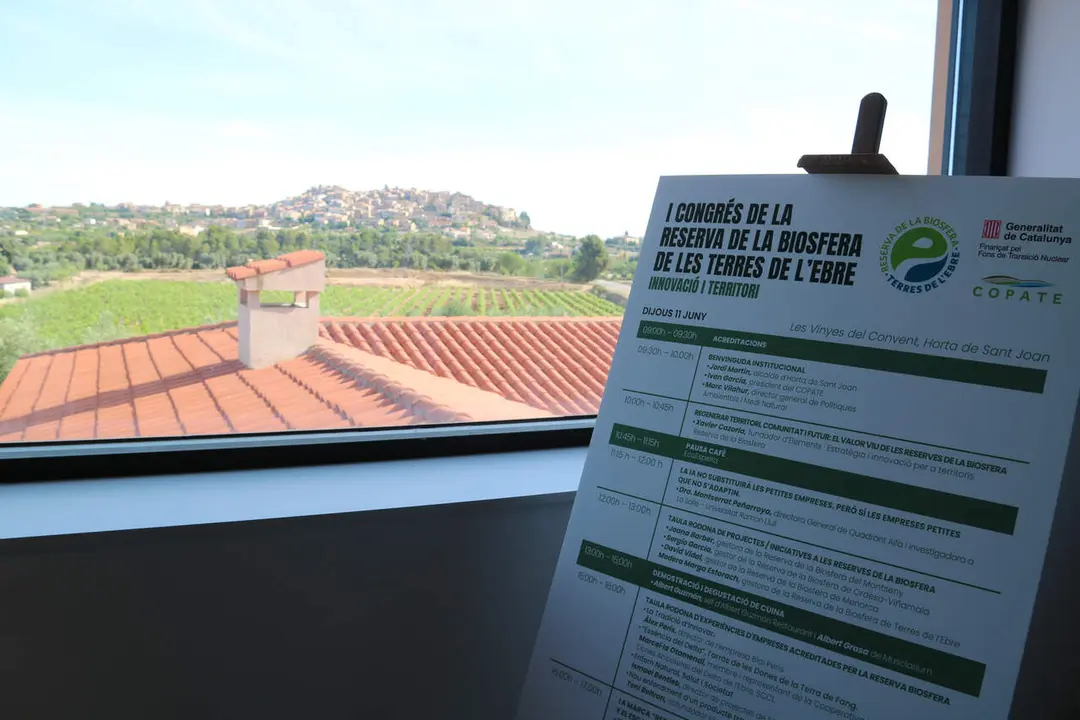

The Terres de l'Ebre Biosphere Reserve wants to stop relying on temporary subsidies and establish stable financing. This is the challenge presented at the first congress organized in Horta de Sant Joan, where 125 people gathered to give a boost to this international designation.
The Consortium of Environmental Policies (COPATE) has led this key meeting, which comes thirteen years after UNESCO declared the area a Biosphere Reserve. The goal now is to make the brand transform the territory and not just remain a title.
A congress to create alliances and strategies
Participants and objectives
With 125 attendees, the congress served to connect local agents, experts, and institutions. All with the same purpose: to create synergies that make the Biosphere Reserve grow beyond the label.
A clear commitment to innovation and to finding new ways to work the territory, not only from an environmental perspective but also social and economic.
The new strategies proposed
Among the highlighted topics is the development of continuous projects that avoid the back-and-forth of occasional aid. The idea is for the Reserve to have a solid roadmap and secured resources to carry out long-term initiatives.
It is about turning the designation into a real engine of dynamism and territorial transformation from Horta de Sant Joan to every corner of the Terres de l'Ebre.
The challenge of stable financing
Dependence on temporary subsidies
Until now, most of the Reserve's projects have been linked to punctual subsidies, which limit continuity and long-term planning. This situation creates uncertainty and makes it difficult to consolidate activity.
The need to find stable and structural financing is one of the clearest demands that emerged from the congress, a too well-known cliché but still unresolved in many territories with similar recognitions.
Strategies to guarantee resources
The proposals focus on seeking public-private alliances and taking advantage of more structural European and state funds. Mechanisms of own financing are also considered to maintain projects beyond political or economic cycles.
A system that makes the Reserve less vulnerable to change and more capable of generating constant social and environmental impact.
The pending expansion and impact on the territory
An expanding territory
The Terres de l'Ebre Biosphere Reserve is awaiting approval of the expansion that will include the entire territory. This will mean an important scale change, with more protected areas and involved local protagonists.
An expansion that can strengthen the territory’s identity but also poses new management and coordination challenges.
Expected impact on the local community
Local actors expect that the designation will not just be a label but a real engine of change. That its recognition helps improve quality of life, generate sustainable economic opportunities, and preserve natural and cultural heritage.
But the question is clear: how will all this transform into concrete actions that benefit the residents?
If the speeches remain words, the echo of the Biosphere will vanish like the morning mist over the Roques de Benet.
Source of the article: Anna Ferras | ACN