3 keys that explain why the new ITV for campers boosts portable battery sales

The new MOT for camper vans has changed the rules of the game and has multiplied the concern (and sales) around portable batteries. Many users have found that a single screwdriver can turn their installation from legal to an administrative nightmare.
If you have a camper over ten years old, this regulation not only affects your freedom to travel but also restricts how you carry energy. That is why many opt for portable batteries instead of fixed installations, but the smallest detail can change everything.
What does the new PROT 2026/04 instruction from the DGT say about campers?
The DGT has gotten serious with the technical inspection for camper vans of category N1 over ten years old, and this has caused a real shock for users. The procedures and the obligation to legalize fixed electrical installations have escalated administrative pressure.
For this reason, portable batteries, commonly called "power stations," have become the preferred solution. These batteries integrate a LiFePO4 battery, inverter, and regulator in a single unit and can cost over 1,500 euros, but they are more cost-effective than doing all the paperwork for a fixed installation.
Why does this new regulation affect campers so much?
The change means that any fixed modification in the electrical installation must be approved. This creates a clear limit between what can be carried as transported cargo and what is considered a modification.
A fixed auxiliary battery or a screwed-in inverter are permanent parts of the vehicle and, therefore, require homologation. In contrast, a portable battery that can be easily removed and is not fixed is considered ordinary cargo, regardless of its energy capacity.
How does this affect the sale of portable batteries?
Precisely this distinction has caused sales of these batteries to take off: they allow electrical autonomy without needing to pass the MOT or spending on approvals.
But not everything goes: a simple screwdriver fixing the battery can make the MOT consider it a modification and complicate the inspection.
The clear limits to not lose legality with a portable battery
The regulation not only prohibits fixing the battery with permanent elements but also forbids connecting it to fixed electrical installations, such as hidden wires or embedded sockets. This forces homologation of the modification, and it is not always an easy or cheap process.
Also, permanently recharging the battery connected to the alternator or the service battery requires homologation, while charging it with portable solar panels or the 12V socket does not.
What are the 3 red lines that must not be crossed?
- Fixing the battery to the floor or any point of the vehicle.
- Integrating the battery into the camper’s fixed electrical system.
- Installing a permanent charger directly connected to the vehicle’s battery.
It is also necessary to consider the proper securing of the battery during transport, since, weighing up to 35 kg, it can become a danger if it travels unsecured.
The general traffic regulations require correct securing of any cargo, and homologated straps to original vehicle anchorage points are the best option.
What does the DGT say about transport safety?
According to article 14 of the General Traffic Regulations, the cargo must be well secured to avoid accidents or greater damage. Poor stowage can even affect insurance coverage.
Portable battery or fixed installation: which to choose according to use?
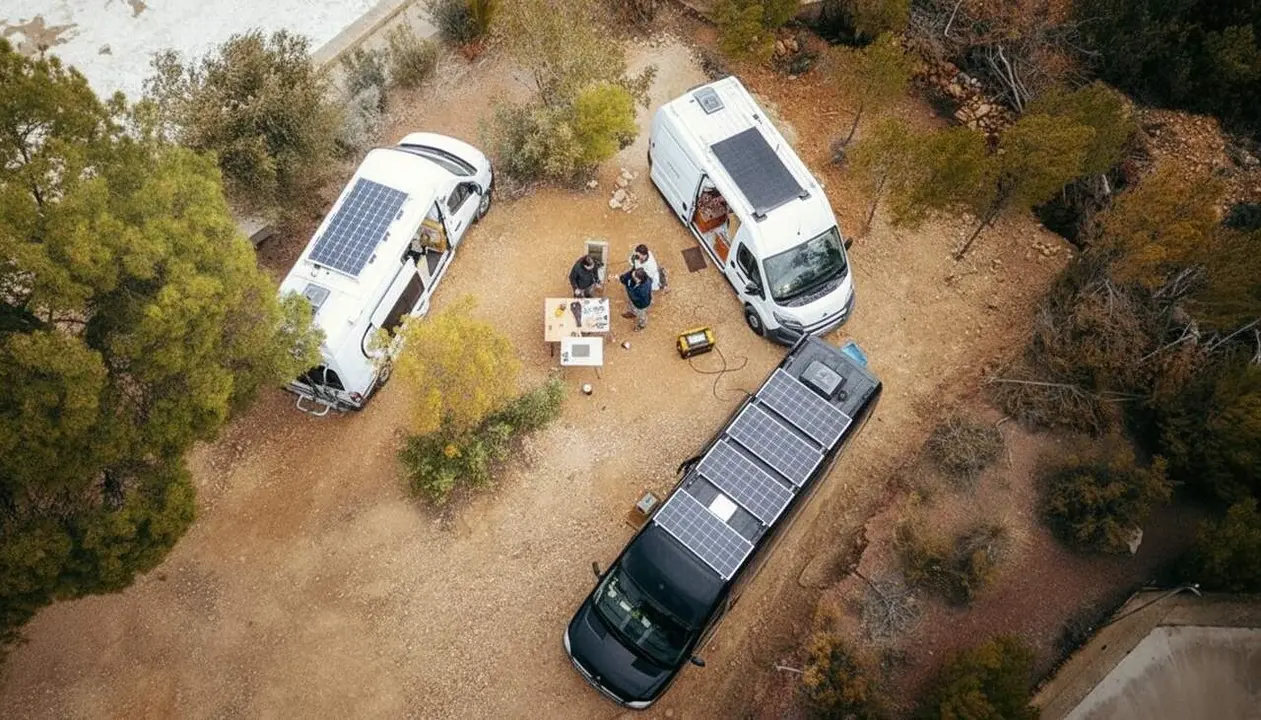
Portable batteries are ideal for short trips or occasional vacations. They allow powering portable refrigerators, LED lights, chargers, or small induction plates without complications.
On the other hand, if the vehicle has a water pump, stationary heating, or a complex installation used often, the fixed option is more comfortable and efficient.
Are portable batteries a legal resource or a trick to bypass the rule?
The reality is that there is no legal loophole: portable batteries are simply not fixed installations but independent and transportable equipment. Therefore, they can be used legally without approval, as long as conditions are met.
What should an owner consider before choosing?
It depends on the use. Travelers seeking autonomy without administrative complications will find "power stations" the best solution. Those looking for a complete installation will have to go through approvals and install fixed systems.
The decision involves weighing comfort, safety, and cost, but above all understanding that the portable battery is not a shortcut but a valid alternative.
The new MOT for campers is not just a regulatory change but a wake-up call to rethink how we carry energy on the road. With sales of portable batteries skyrocketing, it is clear this solution is here to stay, as long as the rules are respected.
Frequently Asked Questions
- What is the difference between a portable battery and a fixed installation in a camper?
- The portable battery is an independent unit that can be easily removed and does not require approval. The fixed installation is permanent and requires approval and annotation on the technical sheet.
- What actions cause the MOT to consider a portable battery as a modification?
- Fixing the battery with a screwdriver, connecting it to fixed electrical systems, or installing a permanent charger connected to the alternator require homologation of the modification.
- How should a portable battery be transported to comply with regulations?
- It must be secured with approved straps to the vehicle’s original anchorage points to avoid risks in braking or accidents.