URV applies a fast method to classify museum bones
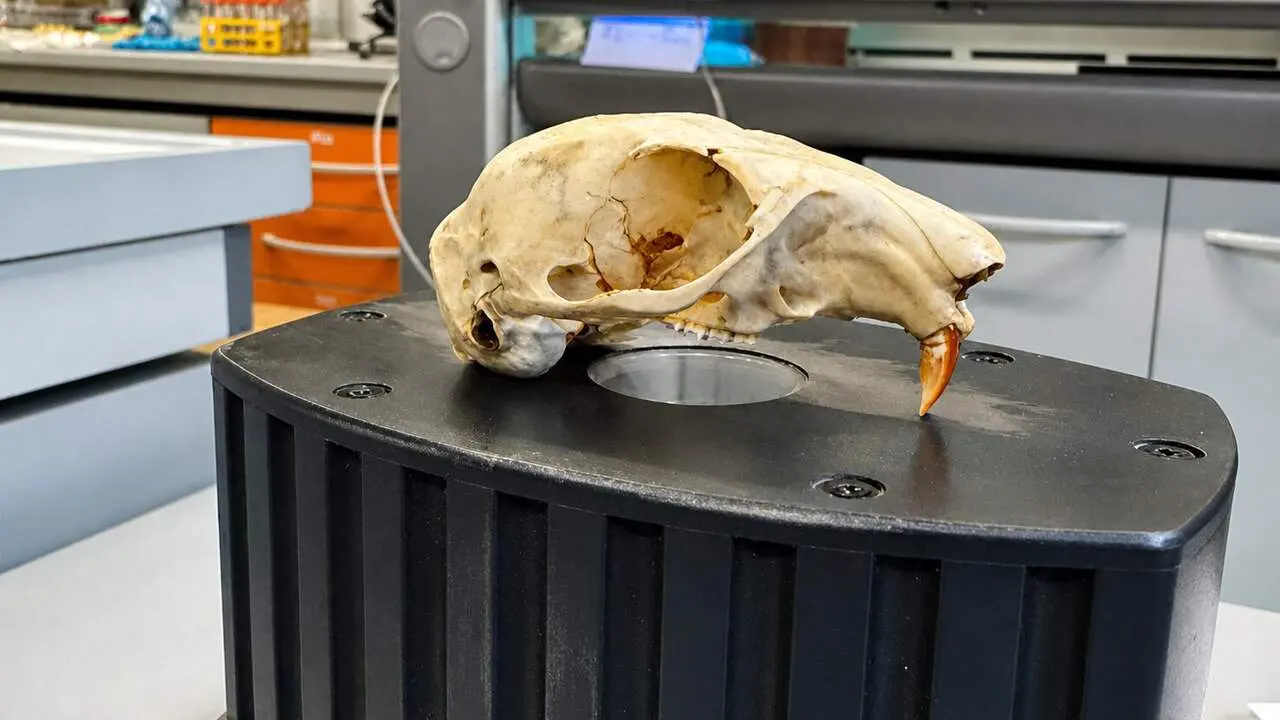

A new technique allows classification of museum bones according to their age without damaging the pieces. This innovation promises to revolutionize how museums in Tarragona and the rest of Catalonia manage their collections.
Researchers from the Rovira i Virgili University (URV), in collaboration with the Museum of Natural Sciences of Barcelona and the Italian University of Insubria, have applied a method based on near-infrared (NIR) spectroscopy to determine the age of bones without the need for extractions or material damage.
How the technique works and why it is an advance for local research
The combination of spectroscopy and chemometrics
The methodology uses infrared radiation to analyze skulls and jaws of red squirrels, a species present in the province of Tarragona. The radiation interacts with the bone and generates a spectrum indicating which parts of the light have been absorbed. This information, combined with chemometric tools that process mathematical and statistical data, allows establishing a reliable model that differentiates old and modern samples.
The Chemosens research group at URV has led the chemometric analysis, achieving 100% reliability in the classification of skulls and between 87% and 95% in jaws.
Benefits for Tarragona museums
Local museums that house collections of animals can use this method to date bones without damaging them, a crucial detail for pieces of patrimonial or scientific value. This technique avoids the destructive extractions that had to be done with X-rays and allows the analysis to be done in less than a minute, speeding up processes and broadening the range of species that can be studied.
Furthermore, the possibility of extending this technique to other materials, such as birds or taxidermied skins, opens doors to deeply studying the fauna of the Costa Daurada and the Camp de Tarragona.
Specific details of the study and obtained results
The analyzed samples and their age
The work focused on 59 specimens of red squirrels, divided between historical individuals collected between 1916 and 1923 and modern ones between 2005 and 2021. This selection allows comparing differences in bone composition according to age and validating the method with a real and representative sample.
Historical bones, more porous and with higher environmental humidity due to degradation, show characteristics detectable with infrared radiation that the model can clearly identify.
Technical aspects that make the difference
The key innovation lies in applying a chemometric model that evaluates which parts of the spectrum are more reliable to avoid errors. This has allowed refining the classification and ensuring that the method is useful for collections with little prior information about their date.
Jordi Riu, a URV researcher, highlights that the analysis is fast, precise, and non-invasive, a combination difficult to achieve until now.
Local perspectives and future applications
Impact for research and conservation in Tarragona
The laboratories and museums in the province could begin implementing this technique to better catalog their collections and facilitate studies on the evolution of local fauna. The rapid and safe identification of bones will allow obtaining more reliable data about the past biodiversity of the region.
This can also help protect endangered species, as knowledge about their history and the environmental changes that have affected them expands.
Possibilities for expanding the method
The project opens the door to studying other species, especially birds and taxidermied skins, provided that a sufficient number of reference specimens is available. This could make the URV a reference center for the rapid and non-destructive analysis of bones and biological materials in Catalonia.
A future with more data and less damage to scientific samples.
But, as always, science advances and bones remain still, waiting for someone to tell their story without breaking them.
Sources consulted
- Rovira i Virgili University – Method to classify bones according to age
- Analytical Chemistry – Original scientific publication of the study
Source of the article: Rovira i Virgili University