Mas dels Frares advances the harvest: heat, More than 25,000 kg and good red wines
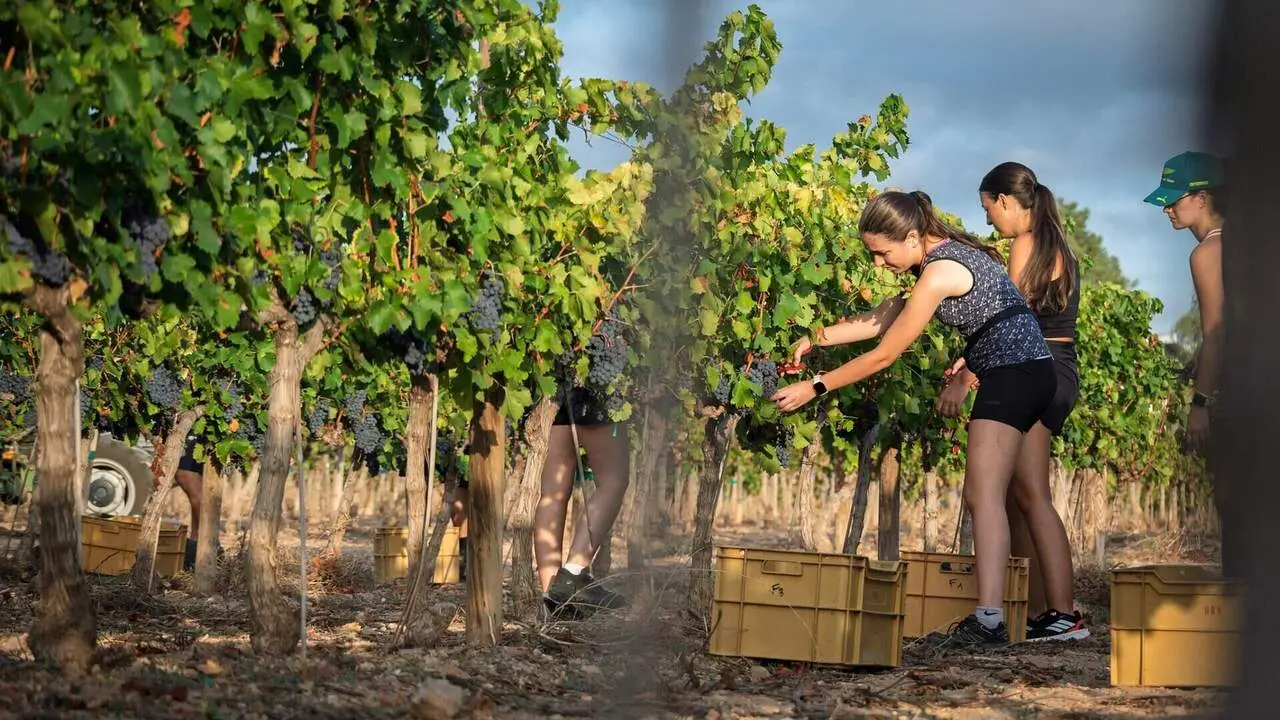

The Mas dels Frares harvest has been one of the earliest and fastest at the URV experimental winery. The heat of the last three months has advanced the harvest, which started on August 1st and is finishing this week, much earlier than in many other years.
The first indications point to a production similar to last year’s and good quality, especially in red wines. Behind this result are grapes, soil, and a lot of work from students who turn classroom theory into a day with scissors, boxes, and rush.
Heat accelerates a harvest that usually arrives later
Why did the harvest start on August 1st?
The harvest was brought forward due to the high temperatures of the last three months. At Mas dels Frares, the experimental winery of the Faculty of Enology at the Rovira i Virgili University, the harvest began on August 1st and is considered finished this week.
The difference with other campaigns is notable: there are years when the harvest does not end until late September. This time, the ripening pace of the grapes and the weather conditions concentrated the work into especially intense weeks.
The calendar could have been moved up even more, according to information from the winery, but the faculty's logistics did not allow it. The vineyard could have been ready earlier; the university organization, not so much. Nature usually does not consult the class schedule.
According to Rovira i Virgili University, this is one of the earliest and fastest harvests in the history of the experimental winery.
How has the vineyard endured the summer heat?
The abundant winter rains left a considerable water reserve in the soil. This accumulated moisture has helped the vineyards better withstand the summer heat, although the plants ended up quite exhausted after the harvest.
The heat and the few summer rains have, at the same time, had a favorable effect on the health status of the plants. No fungal problems or other diseases have been detected, according to information provided by the winery.
The result is a combination that does not always occur: lots of heat, little rain during the summer, and a vineyard that arrives tired but healthy. The winter water reserve has been decisive in preventing the summer drought from having a more severe effect on the vines.
This does not mean the heat hasn’t left its mark. The final state of the plants allows students and winery teams to study how water stress, irrigation, and sunlight affect the different grape varieties.
Production similar to last year and better expectations for reds
How many kilos of grapes are expected?
Final data still need to be confirmed, but the winery expects a high production similar to last year. In that campaign, over 17,000 kilos of white varieties and over 8,000 kilos of red varieties were harvested.
These figures place the reference volume above 25,000 kilos in total, summing both major families of grapes. The forecast for this harvest points to maintaining a similar level, still pending final count.
Quantity, therefore, is not the only indicator closely followed by the winery. In viticulture, harvesting a lot does not guarantee a better wine by itself: maturation, health status, and the response of each variety during vinification also matter.
Information from the URV indicates that the weather conditions allowed complete ripening of the red grape varieties. This is why the quality expectations are especially good for red wines.
Which varieties are harvested at Mas dels Frares?
The winery works with a wide range of varieties, both white and red. The harvest is not a uniform operation: each grape responds differently to soil, heat, and ripening timing.
- White varieties: chardonnay, xarel·lo, parellada, macabeu, and two varieties of muscatel.
- Red varieties: garnacha negra, syrah, cabernet sauvignon, merlot, and ull de llebre.
With this set of varieties, URV produces two sparkling wines, one white wine, and three red wines: young, crianza, and reserva. The current harvest will feed this production, analysis, and learning cycle.
The advanced calendar may have effects on subsequent phases. The planned renovation works for this winter at the winery building will modify the logistics of some processes, especially bottling, which will probably have to be moved forward.
| Scope | Available data |
|---|---|
| Start of harvest | August 1st |
| Last year’s white production | More than 17,000 kg |
| Last year’s red production | More than 8,000 kg |
| Current forecast | Similar quantity and good quality |
A university winery where the harvest serves to learn
What do Enology students do there?
The Mas dels Frares harvest does not primarily aim to produce wine for sale. The winery and experimental fields mainly serve as a teaching and research space for the URV Faculty of Enology.
Enology degree students carry out the harvest with support from technicians and faculty. Anaïs Marín and Martí Davins, who are starting their third year, are participating these days in work that allows them to follow the process from harvest to vinification and the final product.
Davins explains that the practice allows them to see how the whole process works and verify how classroom theory takes shape in the winery. He also highlights the group work, with more experienced students helping those with less practice.
Marín, for her part, considers it useful to have to synthesize and work with much information in a few days. The wine process, she says, continues to surprise her for its complexity and the number of aspects that must be controlled.
The vineyard does not hand over an exam but grades with impeccable clarity. A variety ripens earlier, a plant arrives more tired, or a temperature change modifies the result. Everything is reflected when the grapes enter the winery.
What do they analyze during vinification?
Students put viticulture and vinification knowledge into practice and observe how different decisions and conditions affect the vineyard and grapes. Their work continues after cutting the clusters, during the grape-to-wine transformation.
Among the aspects they analyze are planting, water stress, irrigation, and sunlight. They also study how these factors impact the different varieties, especially when vinification starts at the winery.
- The plant’s response to heat and soil water reserve.
- Differences between white and red varieties.
- The effect of irrigation and sunlight on the grapes.
- The relationship between grape ripening and final wine outcome.
- Changes needed in production logistics.
Teaching is not separated from research. The Mas dels Frares process allows working with real situations and observing their evolution, while the faculty’s various research groups conduct their activities there.
The week of September 15th, the winery will welcome about thirty students from around the world enrolled in the international Master in Innovation in Enotourism, known as Wintour. Their training is more linked to tourism than enology, so for many this will be the first real contact with a winery.
The earliest harvest thus offers two simultaneous readings: a harvest aimed at maintaining production levels and red wines with good expectations, and an open classroom where each basket of grapes serves to study what happens when climate tightens deadlines.
Mas dels Frares closes an early harvest due to heat, with a production forecast similar to last year and especially positive expectations for red wines. The value of the winery, however, is not measured only in kilos or bottles: it is also found in the students who learn the complete process, the research on the vineyard, and the ability to understand what each harvest reveals.
Frequently Asked Questions
- When did the harvest start at Mas dels Frares?
- The harvest started on August 1st. The heat of the last three months moved up the calendar and made it one of the earliest harvests at the winery.
- What production is expected this campaign?
- The winery expects high production similar to last year. That campaign exceeded 17,000 kg of white varieties and 8,000 kg of reds.
- Will the red wines be good?
- The forecasts are especially positive for red wines because the weather conditions allowed complete ripening of the grapes of these varieties.
- What is the function of the Mas dels Frares winery?
- Its main function is teaching and research. Students practice viticulture and vinification there, with the support of technicians and faculty from the Faculty of Enology.
Sources consulted
- Rovira i Virgili University – Harvest data, production, varieties, and teaching
Article source: Rovira i Virgili University