Tarragona puts the Spoken Dances in front of the mirror: 3 days to discuss inequalities

The III International Congress of Spoken Dances will analyze how popular street theater makes inequalities and social conflicts visible. The event will take place from September 24 to 26 in Tarragona, with the Catalunya campus of the Rovira i Virgili University as the central point.
Twelve years after the last edition, spoken dances return to the table. Not as a museum piece, but as a living practice that still occupies squares and popular festivals — and that now must face uncomfortable questions about gender, power, and colonial legacies.
Tarragona recovers a Congress that looks to the street
Why does this meeting matter to the locals?
Because spoken dances are part of the festive memory of the southern counties and the south of the Principality. In Tarragona, Reus, and Torredembarra, they are not only ancient texts: they are performances still linked to squares, groups, and a specific way of building community.
The congress, organized by the Department of Catalan Philology, will turn this tradition into an object of international debate. The proposal starts from a clear idea: what happens during a festival also explains who has a voice, who is left out, and what conflicts a society carries.
The Rovira i Virgili University will host the third edition after twelve years without a new call. The first meeting established the bases to categorize these expressions of popular theater; the second, held in 2014, expanded the comparison with similar expressions from other territories.
From festive recovery to university research
Spoken dances shaped a distinctive festival model in the southern counties. In some municipalities, they never disappeared; in others, they were revived with the restoration of democratic town councils from the late 1970s onward.
Research on ancient texts began in the Catalan Theater History course of the Catalan Philology degree, taught by Guillem-Jordi Graells until 1981 at the then Delegation of the University of Barcelona in Tarragona, the embryo of the future URV.
Later, Professor Montserrat Palau took over within the Department of Catalan Philology at the URV. This second stage culminated in the first congress, held in 1990 under the title “Els Balls Parlats a la Catalunya Nova. Catalan popular theater,” which helped establish a shared name and category.
Gender and anticolonial critique on stage
What inequalities will the Congress study?
The event will examine the role of women in spoken dances and how this role has been conditioned by the historical context. It will also analyze the language of the speeches, the presence of saints and the Virgin Mary, and the relationship of these figures with the communities where the performances take place.
The program focuses on three lines that change the usual reading of this popular theater: gender perspective, counter-hegemonic resistance, and anticolonial critique. Put plainly: it is not enough to preserve a tradition if one does not examine what it says, who says it, and what inequalities it may reproduce.
The communications will also address the updates of spoken dances in response to the visions, conflicts, and inequalities of the 21st century. This is the issue that gives local meaning to a meeting with participants from very diverse territories: conflict may change shape, but it continues to appear in the text, characters, and staging.
What presentations are part of the program?
The inaugural lecture will be given by Jordi Bertran, who will speak about “Humanism in the genesis of the new staging formula of spoken dances” on Thursday the 24th at 9:45 a.m. The closing lecture will be by Montserrat Palau, titled “Saints, martyrs, and punished transgressors. Misogyny and inertia,” scheduled for Tuesday the 25th at 6 p.m.
The program includes perspectives on various spaces and traditions:
- Oscar-Armando García Gutiérrez, professor at the National Autonomous University of Mexico, will speak about dialogued dances in Latin America.
- Raül Sanchis Francès, member of the LaiREM/Iconodansa research groups at URV, will address the Moors and Christians festivals from a decolonial perspective.
- Patricia Heiniger-Casteret, from Pau University, will analyze the historical and linguistic context of pastorals performed in Basque and Occitan.
The diversity of origins is not decoration. It allows comparing forms of popular theater that have grown in different territories and seeing what they share, what they hide, and what they have been transforming over time.
Four Spoken Dances will return to Plaça de les Cols
When and where can the show be seen?
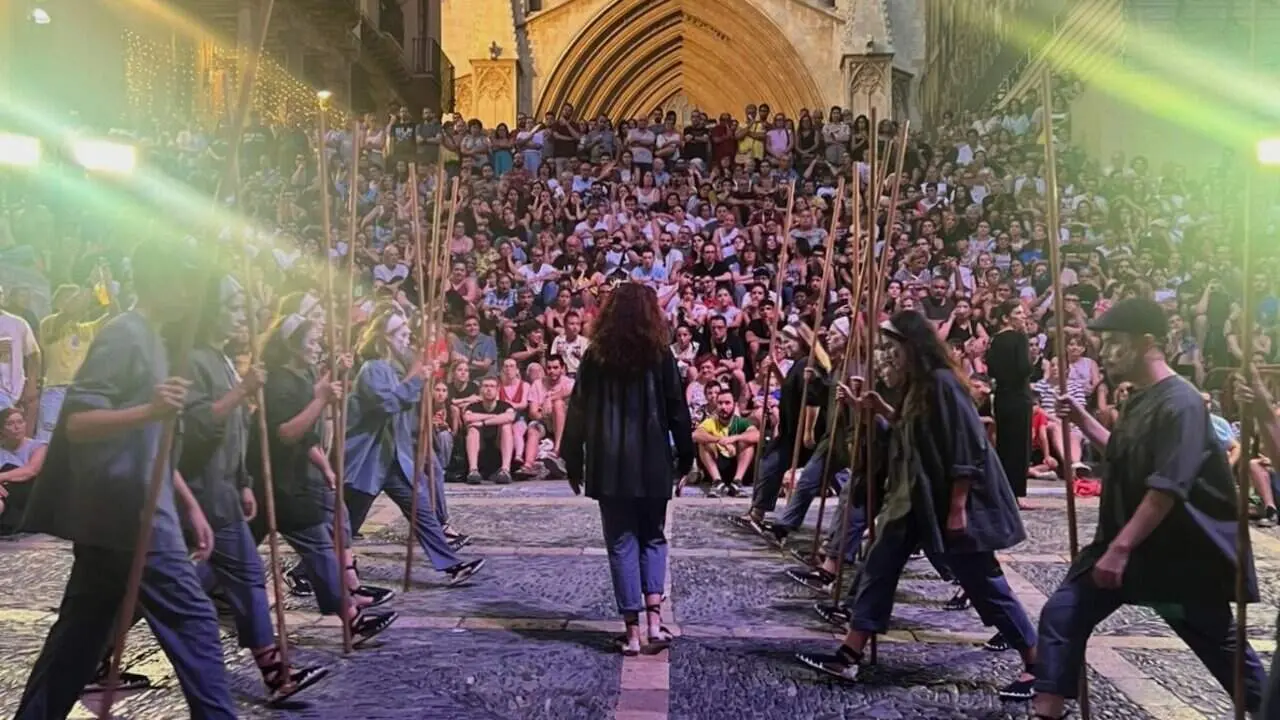
The spoken dances showcase will take place on Saturday, September 26 at 10:30 a.m. in Plaça de les Cols in Tarragona. For readers who want to see what lies behind the presentations, this will be the most direct part: the street will again be the space for exhibition, conversation, and participation.
The square will host four performances linked to Tarragona, Reus, and Torredembarra. These are specific proposals, with proper names and identifiable provenance:
- The Dance of Sebastiana from Castillo de Tarragona.
- The Dance of Malcasats from Torredembarra.
- The Dance of Rosaura from Reus.
- The Dance of Mother-in-Law and Daughter-in-Law from Tarragona.
This selection shows the territorial continuity of the phenomenon. Tarragona contributes two performances, while Reus and Torredembarra add two more traditions from the nearby area. The research, therefore, does not remain closed inside the lecture hall: it goes out into the street and stands before the audience.
What explains that this tradition still endures?
The persistence of spoken dances relates to their ability to adapt to popular festivals and societal changes. Some municipalities have maintained them continuously; others have revived them after decades of disappearance, especially following the recovery of democratic town councils.
The congress proposes reading this continuity with a less complacent eye. A tradition is not immobile because it is old. Characters, speeches, and religious figures may be preserved, but the community that performs them can also discuss their meaning and propose new readings.
The connection between research and the square is the detail that makes the meeting relevant beyond the university. In Tarragona, debates about gender and anticolonial critique will not remain only academic events: on September 26 they will have voices, costumes, music, and audience in the city center.
Spoken dances remain alive because they can still tell a community’s story, but the Tarragona congress reminds us that telling it also means revising its shadows. Research, debate, and the showcase at Plaça de les Cols form a single story: a popular tradition that endures when it allows itself to be discussed, not when it merely repeats the usual script.
Frequently Asked Questions
- When will the III International Congress of Spoken Dances take place?
- The congress will be held from September 24 to 26 in Tarragona. Sessions will take place in the Graus Hall at the Catalunya campus of the Rovira i Virgili University.
- What central theme will the meeting address?
- The congress will study spoken dances from the perspectives of gender, counter-hegemonic resistance, and anticolonial critique, focusing on current inequalities and social conflicts.
- Where can the spoken dances showcase be seen?
- The showcase will be on Saturday, September 26 at 10:30 a.m. in Plaça de les Cols in Tarragona, featuring four performances from Tarragona, Reus, and Torredembarra.
- Which spoken dances will participate?
- Performances will include the Dance of Sebastiana from Castillo de Tarragona, the Dance of Malcasats from Torredembarra, the Dance of Rosaura from Reus, and the Dance of Mother-in-Law and Daughter-in-Law from Tarragona.
Sources consulted
- Rovira i Virgili University – Information about the congress, the program, and the showcase
Article source: Rovira i Virgili University