The Amazing Science of Castells arrives in Tarragona with 14 Posters
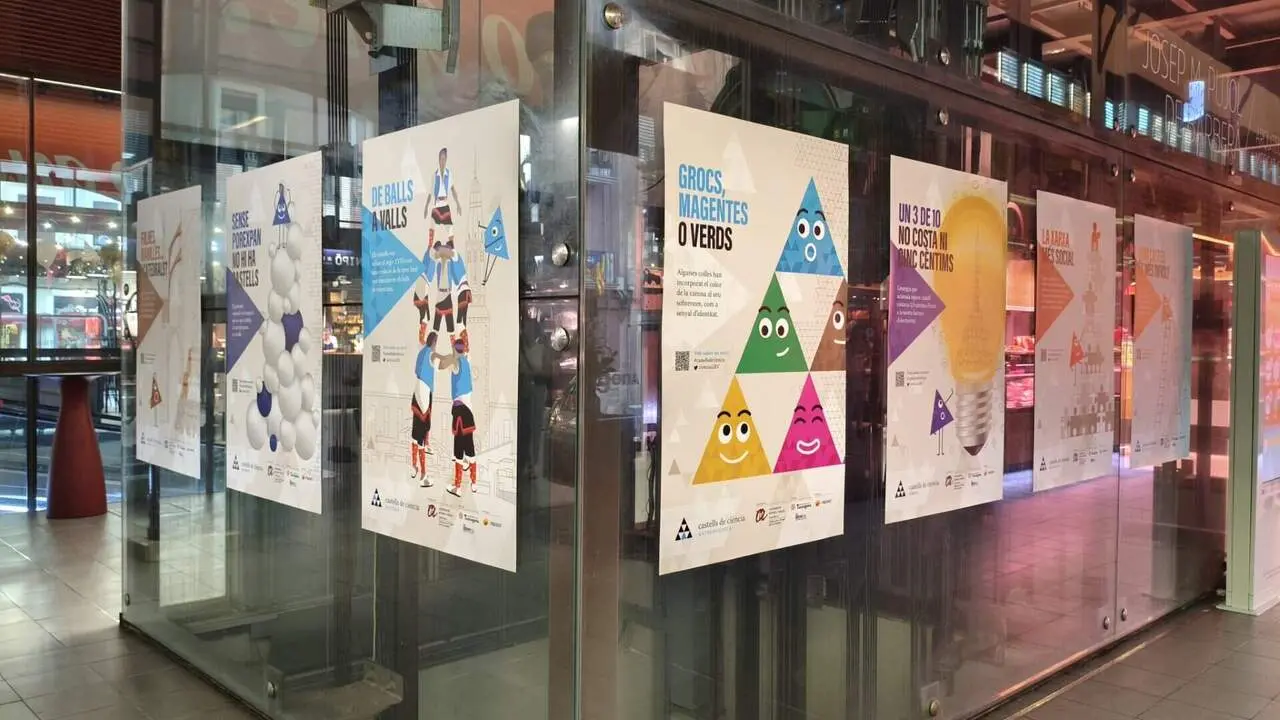

The exhibition "Castells de ciència" explains the casteller phenomenon through 14 illustrated posters and various scientific disciplines. The exhibition can be visited at the Central Market of Tarragona until October 13 and answers questions that go far beyond physical effort.
What do handcuffs have to do with the flying buttresses of a Gothic cathedral? How much energy does a ten-story castle accumulate? And why is the children’s helmet made of expanded polystyrene? The answer lies in physics, architecture, mathematics, and many other areas.
14 Posters to See Castells with Different Eyes
What can be seen at the Central Market of Tarragona?
For the public of Tarragona, the proposal has a very specific advantage: it allows to see a scientific exhibition in the very everyday place where many people go shopping. There is no need to enter a laboratory or read a treatise; it is enough to stop in front of the posters and look at the castells as if they were a construction, a mathematical problem, or a social phenomenon.
The exhibition brings together the 14 illustrated posters created throughout the “Castells de ciència” project, promoted by the Science Communication and Dissemination Unit of the Rovira i Virgili University, with the collaboration of the URV Chair for the Study of the Casteller Phenomenon and the support of Repsol.
According to Rovira i Virgili University, the panels allow knowledge to be brought closer to non-specialized people through a cultural phenomenon deeply rooted in the territory. A simple formula, but with much substance: what seems to be a tradition can also be a scientific question.
The contents cover physics, chemistry, architecture, anthropology, sociology, history, mathematics, psychology, nursing, nutrition, geography, and Catalan philology. The variety is not decorative. Each discipline puts the focus on a different part of casteller activity.
- Physics: the potential energy accumulated in a 3 of 10.
- Architecture: the function of some structural elements, comparable to the flying buttresses of Gothic cathedrals.
- Mathematics: the use of algorithms to study the difficulty of the constructions.
- Chemistry and materials: the characteristics of the expanded polystyrene of the helmets.
How is the Information on the Panels Expanded?
Each illustration functions as a gateway to broader content. Through a QR code, the visitor can access a divulgative article that develops the issue raised on the poster.
This system allows the visit to have two rhythms. Those who only want a quick idea can stay with the image and main text; those who want to know how the energy of a 3 of 10 is calculated or how the difficulty of a castell is analyzed can continue reading on their mobile phone.
Science does not always come with a white lab coat. In this case, it comes with a waist sash, a helmet, and an entire team working at the same time. The result is an exhibition designed to make visible the mechanisms behind a construction that, viewed from the outside, may seem only a matter of balance and courage.
From the Children’s Helmet to the Heat of the Diades
What Human Issues Does the Exhibition Raise?
For the castellers and families who participate in the diades, this part is especially close: the posters do not talk only about the structure of the castell, but also about the people who make it possible. The exhibition addresses the social cohesion of the teams, psychological preparation, injury prevention, and emotional well-being.
It also features aspects related to nursing and nutrition. The scientific perspective thus serves to examine what happens before, during, and after a performance: how the body is prepared, how pressure is managed, and which conditions help reduce risks.
Another poster focuses on the helmet worn by the children and the expanded polystyrene it is made of. The initial question is very specific—why this material?—but it opens an explanation about protection and prevention within casteller activity.
The social dimension also occupies its own place. The teams are presented as spaces of cohesion, a reading that directly connects with the way the casteller phenomenon is organized and lived in the territory. It is not only about those who climb: it is the network of people who rehearse, accompany, prepare, and support the construction.
How Can Extreme Heat Affect Casteller Diades?
Rising temperatures may force rethinking the schedules, duration, and conditions of casteller diades. This is one of the most recent contents of the initiative and is based on data collected in casteller squares and on the perception of members from different teams.
The issue is of particular interest in a territory where outdoor performances are part of the cultural calendar. The exhibition does not present a single answer but a practical question: what will need to change if episodes of extreme heat become more common?
Schedules can be a protective factor. So can the duration of performances and the conditions in which they take place. The project puts these variables on the table and relates them to the participants’ health, without separating tradition from the physical conditions that make it possible.
The proposal finds here one of its most current points: to look at castells as a living activity, capable of adapting to the changes affecting the squares and teams. For the local reader, the question is not abstract. It has to do with when diades are held, how long they last, and how participants are protected.
Five Years Turning Castells into Scientific Dissemination
When Did the "Castells de Ciència" Project Start?
For Tarragona, the project is of interest because it connects two very nearby realities: research at Rovira i Virgili University and the casteller phenomenon. “Castells de ciència” was born in 2021 with the intention of bringing scientific concepts closer to a non-specialized audience using castells as a guiding thread.
Since the beginning, the initiative has incorporated new disciplines and formats. The posters are only part of a path that includes divulgative articles prepared by URV researchers, animated videos, talks, and various street activities.
This path explains why the current exhibition is not an isolated collection of panels. It is the visible result of a project that has gradually added questions and ways to explain them. First comes the image; then, the content that allows understanding it more calmly.
The initiative has also led to the first documentary about castells and science, premiered this spring. The project, therefore, is no longer limited to a single room or a single medium: it combines illustration, written dissemination, audiovisuals, and in-person activity.
Which Institutions Participate?
The Science Communication and Dissemination Unit of URV, ComCiència, promotes "Castells de ciència." The project counts on the collaboration of the URV Chair for the Study of the Casteller Phenomenon and the support of Repsol, which has accompanied it from the beginning.
This combination of agents allows connecting university knowledge with a cultural expression recognized in the territory. The editorial key of the project is clear: to explain science based on examples the public can identify with, instead of presenting it as a subject apart from daily life.
| Element | Information |
|---|---|
| Exhibition name | "Castells de ciència" |
| Space | Central Market of Tarragona |
| Visiting dates | From September 1 to October 13 |
| Posters | 14 illustrations |
| Driven by | Science Communication and Dissemination Unit of URV |
| Collaboration | URV Chair for the Study of the Casteller Phenomenon |
| Support | Repsol |
The exhibition can be visited until October 13 at the Central Market of Tarragona. The most interesting thing is that it does not ask the visitor to choose between popular culture and science: it shows that when you look closely at a castell, both are already there.
"Castells de ciència" puts 14 posters, many disciplines, and five years of project at the service of the same idea: castells can also be understood through physics, mathematics, health, and sociology. The visit to the Central Market of Tarragona offers a direct way to see what is behind a 3 of 10, a helmet or a diada subjected to heat. And it leaves a very alive question: how many other scientific stories are still hidden in the casteller squares?
Frequently Asked Questions
- Where can the "Castells de ciència" exhibition be visited?
- The exhibition can be visited at the Central Market of Tarragona until October 13. It brings together 14 illustrated posters about the relationship between science and the casteller phenomenon.
- How many scientific disciplines does the exhibition cover?
- The exhibition addresses fields such as physics, chemistry, architecture, anthropology, sociology, history, mathematics, psychology, nursing, nutrition, geography, and Catalan philology.
- What does it explain about climate change?
- One of the most recent contents analyzes how rising temperatures and episodes of extreme heat can affect the schedules, duration, and conditions of casteller diades.
Sources consulted
- Rovira i Virgili University – Information about the exhibition and the “Castells de ciència” project
Article source: Rovira i Virgili University