Amposta gathers 6,000 independence supporters, but the police count 1,600
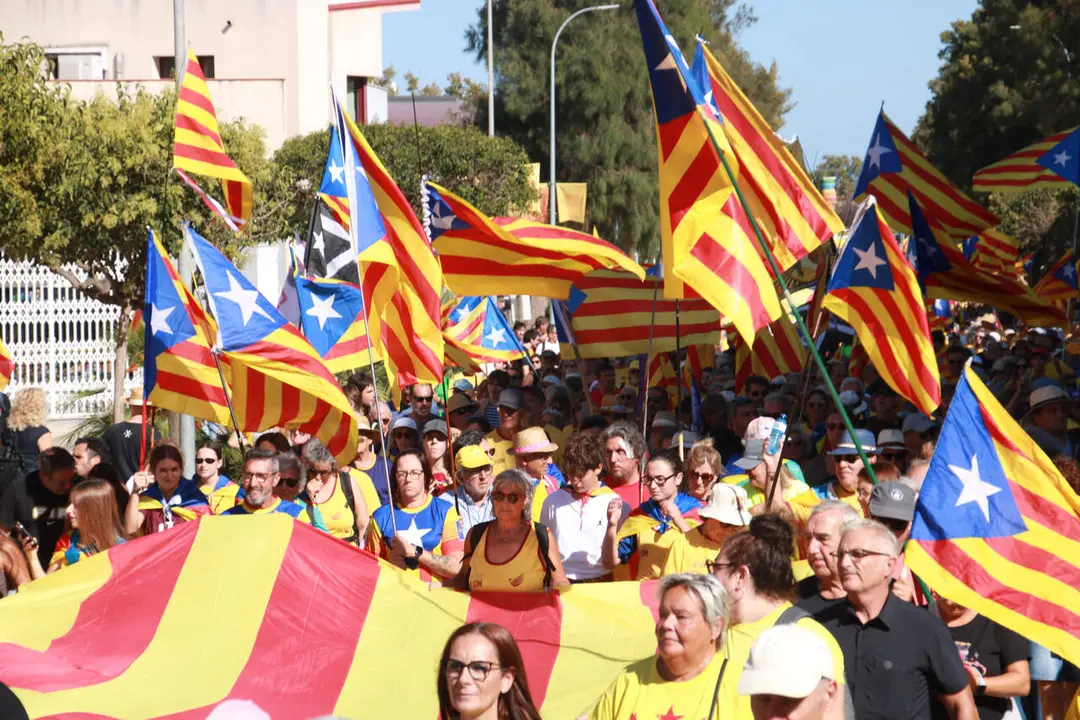

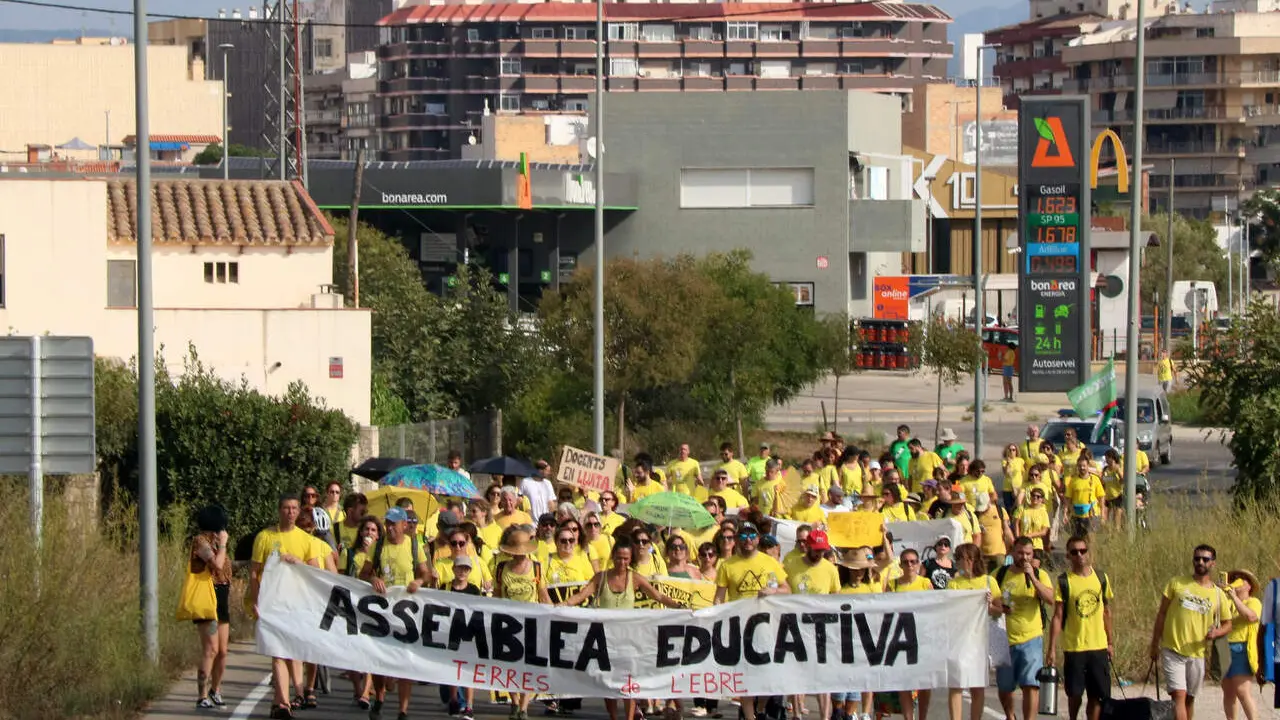
The pro-independence demonstration in Amposta has gathered between 1,600 and 6,000 people, depending on whether the figure is given by the police or the ANC. The two columns crossed the city center of the Montsià capital up to the Hanging Bridge with esteladas, yellow shirts, and the rhythm of a batucada.
The difference in numbers is not a minor detail: it explains two ways of viewing a mobilization that no longer has the crowds of previous years, but that still maintains militancy, speeches, and the capacity to convene. In Amposta, the message has been clear: language, public education, and independence, with resilience as the word of the day.
Two columns and the same route to the Hanging Bridge
For the residents of Amposta and the Terres de l’Ebre, the mobilization had a very concrete dimension: it occupied well-known streets and turned the city center into the setting of a political claim. It was not a static gathering, but a march with two routes that ended up converging.
What was the route of the demonstration?
The Present Column started at 4:30 p.m. on Sebastià Juan Arbó Street. From there it advanced towards Ràpita Avenue, passed through Sant Josep Street, and reached the N-340.
At this point, it met the Future Column. The two groups continued together to the Hanging Bridge of Amposta, where the final stage was set. The participants came from the Lleida and Tarragona counties, as well as from the Terres de l’Ebre.
- Start: Sebastià Juan Arbó Street.
- Pass through downtown: Ràpita Avenue and Sant Josep Street.
- Convergence: N-340.
- End: Hanging Bridge of Amposta.
How many people participated?
The Catalan National Assembly (ANC) estimated attendance at 6,000 people, while the police forces put it at 1,600. The gap between the two figures is large enough to make the count one of the central elements of the day.
The police figure amounts to just over a quarter of the ANC’s estimate. Beyond which number prevails in headlines and debates, the march had enough presence to travel through several streets of Amposta and fill the route to the river with pro-independence chants.
Resilience as a response to a smaller mobilization
The question that interests readers in the region is what remains when the demonstration no longer has the size of other years. In Amposta, the participants’ response has been to keep taking to the streets and claim that the movement has not disappeared, although it recognizes that the convocations are less massive.
What have the demonstrators defended?
Independence has been the main thread, but the arguments have expanded towards defending the Catalan language, public education, and the fight against fascism. The slogan of not renouncing the nation appeared in speeches and chants during the march.
Jordi Ferré, from Valls, explained that he participates for the same reasons as in 2016 and 2017: to fight for independence, to claim it, and to show that they are still there. He admitted that the mobilizations are not as massive but defended the need to resist.
“Things are not easy, we already knew that and we have to be resilient,” he said. Ferré added that it is necessary to remain mobilized and described the Diada as an “act of coexistence.”
Isabel Quadrat, a resident of Alcanar, expressed a similar hope. She said she participates because she hopes things will change and still believes in achieving a sovereign country. She also called on the pro-independence parties to listen to the citizens.
Why have people of different ages participated?
Among the attendees were young people from Cambrils and Morell, who explained that they demonstrate because many people do not see the importance of independence. Roger warned that part of the youth feels attracted to far-right discourses and Spanish nationalist referents.
His reading is especially significant because it places the political battle in a generation that, according to him, presents itself as apolitical, while the youth who do consider themselves political tend to be more polarized. The analysis is not a statistical fact, but the testimony of a participant who sees how the priorities of his peers are changing.
Roser Casanova, from Amposta, emphasized school. Since she teaches Catalan to newcomer mothers in educational centers, she participated to defend dignified and quality education for children.
“The least we can do is claim it,” she said. For Casanova, the Diada served to recharge the backpack before starting the school year and to defend that eventual independence would improve schools.
The ANC demands a pro-independence majority and rejects xenophobia
The final stretch of the demonstration brought the political dispute to the front of the Hanging Bridge. For the local reader, this is the point where the general message of the march became a concrete discussion about pro-independence parties, Catalan Alliance, and the role of the ANC.
What did Josep Franch request?
Josep Franch, member of the ANC and coordinator of the Present Column, defended the need to recover a majority of pro-independence parties in the Catalan Parliament. He also linked incidents such as the removal of an estelada from a young person during a football match with the reactivation of the movement.
Franch maintained that without independence there will be no improvements in education, language, health, or housing. In the case of Catalan, he denounced that, despite the perception that Terres de l’Ebre is an area with high use of the language, he observes that more and more people are leaving it aside.
The ANC leader defended that his organization does not accept xenophobia. At the same time, he stated that they will not set red lines for parties that define themselves as pro-independence, although he questioned whether Catalan Alliance truly talks about independence.
How did the Amposta event end?
When the two columns arrived at the stage, the demonstrators shouted “out fascists” after Catalan Alliance supporters displayed the party’s flags. The verbal tension was limited to the slogans raised during the event.
Then two human towers (pilars) of the Xiqüelos and Xiqüeles del Delta and the Castellers de Tortosa were raised. A manifesto was also read and speeches were made before ending the day with the Cant dels Segadors, the Virolai, and other Catalan anthems.
The Amposta demonstration thus leaves three facts that better explain the day: between 1,600 and 6,000 attendees depending on the source, two columns united at the N-340, and a movement that claims its continuity despite having lost volume. The political picture is less massive than at other times but still has streets, names, conflicts, and a concrete route to the Hanging Bridge.
Frequently Asked Questions
- How many people attended the Amposta demonstration?
- The ANC estimated 6,000 attendees, while the police forces reduced the figure to 1,600. The bulletin records both estimates.
- What route did the pro-independence demonstration take?
- The Present Column left from Sebastià Juan Arbó Street and passed through Ràpita Avenue and Sant Josep Street up to the N-340. Afterwards, the two columns continued to the Hanging Bridge.
- What demands did the participants make?
- The demonstrators defended independence, the Catalan language, public education, and the fight against fascism. They also called for more presence of pro-independence parties in Parliament.
Article source: Mar Rovira / Ariadna Escoda / Catalan News Agency