Why putting aluminum foil under the WiFi modem can improve the connection

Have you ever seen someone put aluminum foil under the WiFi modem and wondered if it’s one of those grandma tricks or if it really works? Well, it’s not just a strange viral fad, but there’s a bit of science (and a lot of DIY practice) behind this gesture.
Most of us know that WiFi connection depends on a thousand factors, but placing this metal sheet could be the key to gaining a few points in speed and coverage. But what really happens with those invisible waves coming from the modem? Let’s take a look.
Why putting aluminum foil under the WiFi modem helps have faster internet
Routers emit their signal in the form of spherical coverage, meaning the connection distributes in all directions, including areas where we don’t need it much. This causes the signal strength to be uneven and obstacles such as walls, furniture, or appliances to weaken it.
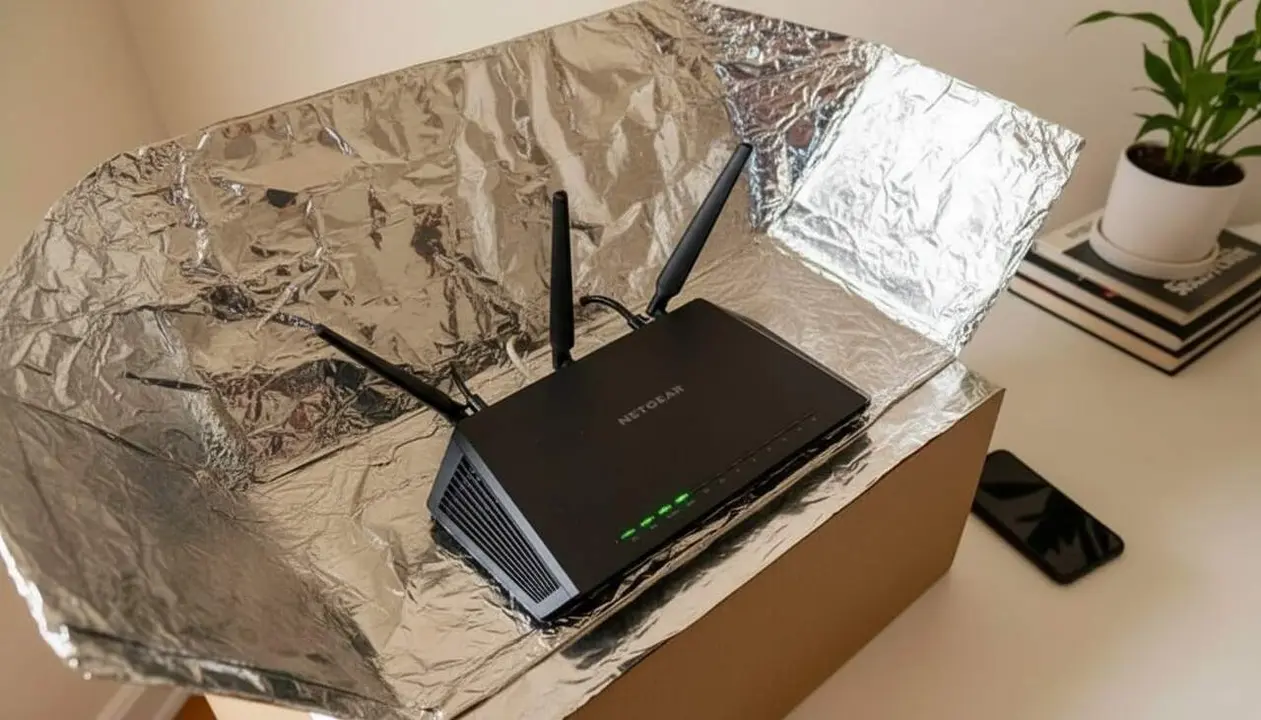
Aluminum foil acts as a reflector that redirects these waves toward specific areas where we want to improve coverage. Thus, boosting the connection in rooms farther from the modem stops being a dream for many.
The origin of a viral trick
The phenomenon became popular after a study by Dartmouth University in 2017, where customized reflectors were created with 3D printing that achieved improvements of up to 50% in limited areas. In home use, this translates into a 10-20% improvement in signal strength, depending on factors such as space layout and construction materials.
Aluminum foil: an economical and easy ally
The best part? Aluminum foil is a cheap and quick solution to implement to improve a connection that, if not bad, can be frustrating. It just takes a bit of patience and knowing where to place it.
How this trick really works
Routers operate at frequencies of 2.4 GHz and 5 GHz, which reflect off metallic surfaces. Therefore, aluminum foil works as an improvised parabolic antenna that concentrates the wave propagation toward a specific point.
This causes the signal not to scatter everywhere but to focus where we really need it, which can increase the quality and intensity of the connection in certain corners of the house.
Tips for doing the trick
- Disconnect the router before handling it.
- Cut a piece of aluminum foil about 20 x 30 centimeters.
- Give it a slightly curved shape to better reflect the signal.
- Place the foil behind the modem, orienting it toward the area you want to improve.
When it doesn’t work as well
Keep in mind that this trick only improves the signal in one direction. This means other areas may become worse or remain just as bad, especially if there are thick walls or interference from other electronic devices.
Also, if you completely cover the modem with aluminum foil, it can trap heat and damage the equipment, which in the long run reduces its lifespan and efficiency.
Considerations and risks to keep in mind
Although aluminum foil is an economical trick, it is not a definitive solution for structural connection problems. The effect is temporary and experimental, and does not replace a good router location or the use of repeaters and more advanced systems.
Experts recommend using it as a partial complement, never to completely wrap the device. Furthermore, the best results are achieved by strategically relocating the modem, placing it in a central spot, away from exterior walls and appliances that may cause interference.
A homemade hack with limitations
If you have a weak signal and don’t want to spend more on equipment, this trick can be a temporary relief that only takes a few minutes to prepare.
How to combine it to improve the effect
The key is to use aluminum foil as a complement, not as the only solution. A good router location and the use of repeaters or more modern WiFi systems will substantially improve coverage at home.
Finally, let’s not forget that technology advances, but sometimes a simple sheet of aluminum foil can also work its magic. It’s a matter of knowing when and how to use it.