
Why do tires resist more when they deform?
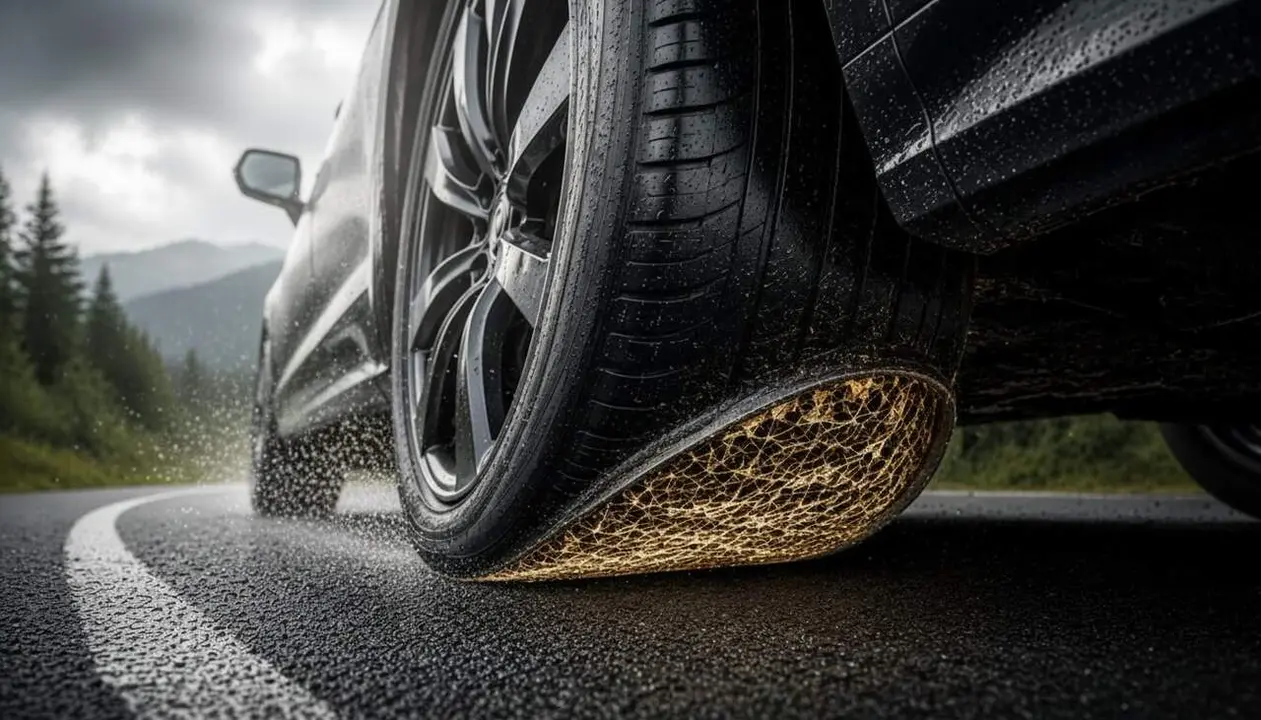

Black tires seem like tamed technology, but they hide a surprising phenomenon. When subjected to extreme stresses, rubber does not weaken but hardens. This breaks the usual logic of materials, which typically break under prolonged stress.
Manufacturers have been exploiting this property for decades without fully understanding why it happens. Now, a team from the University of South Florida has found the key after thousands of molecular simulations. The answer is not that rubber avoids deformation, but that it strengthens thanks to how it deforms.
The carbon black paradox in rubber
Carbon black, tiny nanoparticles, transform a soft material into a rubber capable of bearing enormous loads. This component increases wear resistance and allows it to withstand millions of deformation cycles without fracturing.
The key is a phenomenon known as strain stiffening: the material offers more resistance the more it is stretched. This is puzzling because in almost all other materials prolonged stress opens cracks and weakens the structure.
Theories that never quite fit
For decades various hypotheses have been proposed: that the nanoparticles form internal networks, act as microscopic adhesive, or simply modify the space that rubber occupies. None fully explained the sudden strengthening under high stresses.
A revolutionary molecular perspective
Thanks to molecular dynamics simulations, it has been possible to see how hundreds of thousands of atoms interact inside the reinforced rubber. These simulations reveal that the particles prevent the rubber from shrinking normally when it deforms.
Instead of thinning, the material partially expands in volume, and here lies the secret.
The internal conflict that makes rubber strong
Rubber does not tolerate volume changes well, and the nanoparticles cause it to expand while being stretched. It is as if the material fights against itself to maintain the structure.
David Simmons, one of the researchers, compares the effect to pulling the piston of a syringe filled with water: resistance increases because the liquid is hardly compressible.
Stress distribution and fracture resistance
This internal expansion causes energy not to concentrate in weak points but to be distributed throughout the material. This hinders crack propagation and makes the rubber more resistant when deformed.
Integration of previous theories
The new model incorporates all previous hypotheses: networks, adhesion, and spatial effects are part of a global mechanism that explains strain stiffening.
Implications for industry and beyond
Manufacturers have created sophisticated tires for decades without this microscopic explanation. The sector moves 260 billion dollars annually and must seek a balance between durability, grip, and energy efficiency.
Better understanding this mechanism can permit the design of more rational and precise materials.
Impact on other technologies
Besides tires, reinforced rubber is used in aerospace, energy installations, medical equipment, and industrial machinery. The discovery can improve the safety and durability of these systems.
Less microplastic pollution
If tires can last longer without degrading, microplastic pollution from tire wear would decrease. An unexpected benefit for the environment.
Physics takes giant strides to decipher everyday phenomena that seemed tamed, opening the door to materials that not only resist but get stronger when they start to fail.
This discovery not only alters how tires are made but can change the flexible materials industry everywhere.