An engineer travels through 21 countries in an electric truck and breaks myths
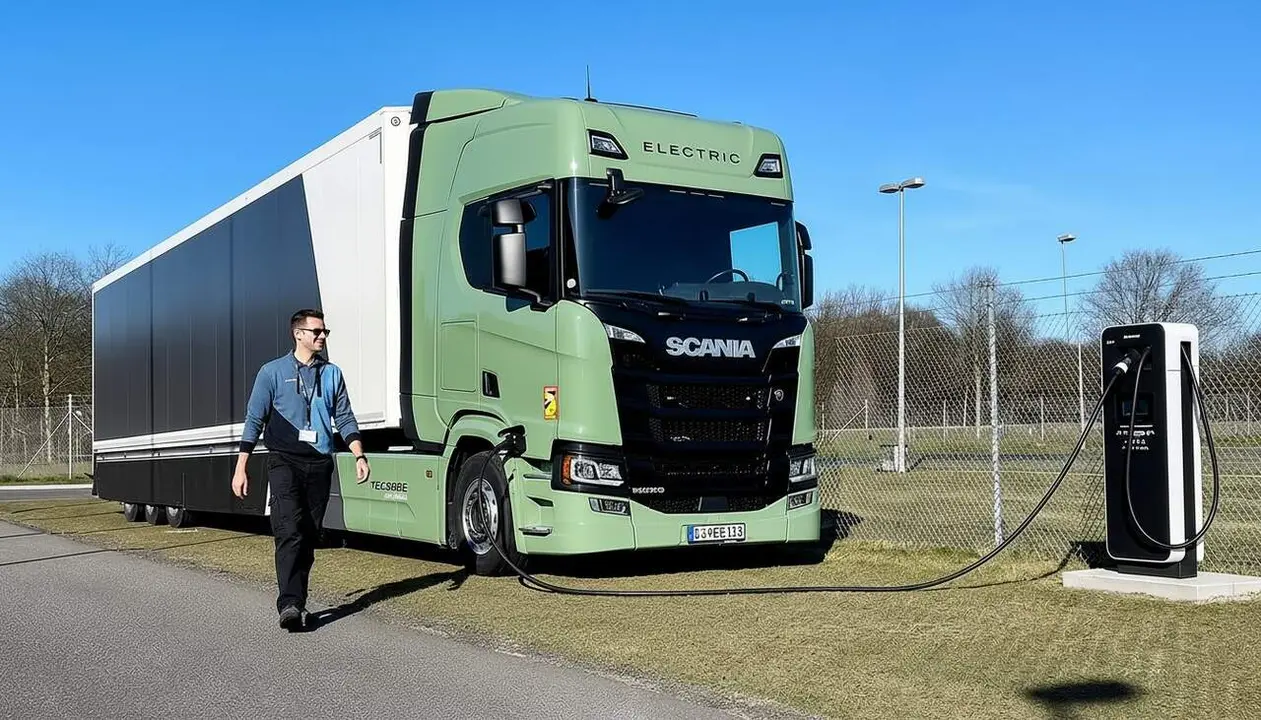

Can you imagine crossing Europe in an electric truck? Well, Anders Gaasedal has done it, and not just to test a vehicle, but to break prejudices and provide fresh data to a sector that still doubts the viability of diesel-free trucks.
His adventure began as an aerodynamic test in Germany and ended up being a journey through 21 countries, accumulating more than 73,500 kilometers on European roads. But what has this Scania engineer really discovered?
The real challenge of an electric truck in Europe
A testing ground on wheels
Gaasedal, head of testing and certification at Scania, decided to drive himself a Scania R45 electric tractor unit with 450 kW of power and a 624 kWh battery. For two and a half years, he used the truck as a mobile laboratory to obtain direct data on consumption, range, and real operation in different countries.
The route crossed from Sweden to Spain, passing through countries such as Germany, France, Italy, or Poland, putting the vehicle to the test under diverse conditions and challenging the perception that an electric truck cannot handle long distances.
Data disproving the great fear of transporters
Contrary to what many think, the recorded consumption ranges between 0.94 and 0.98 kWh per kilometer, even with cold temperatures and highway speeds. Gaasedal highlights that these numbers not only confirm the theory but in some cases exceed it.
Furthermore, he assures that recharging can naturally fit into mandatory breaks, recovering more than 50% of the battery in just 45 minutes, enough to face the next hours of driving without issues.
Infrastructure and driving experience
From frustration to evolution
When he started his journey in 2023, charging points for trucks were scarce and often designed for passenger cars, forcing difficult maneuvers with a 17-meter vehicle. The situation has notably improved, especially in Central and Northern Europe, with more accessible and varied charging points.
Despite this progress, Gaasedal insists that processes still need to be simplified, reliability guaranteed, and the information from stations better integrated into truck navigation systems to avoid relying on external apps.
Comfort and recovery: key factors
The electric truck stands out for being quiet and comfortable, which can reduce fatigue on long shifts. This improvement in the driving experience can be an ally in attracting new professionals to the sector, especially young people.
Moreover, energy recovery during braking and downhill driving is greater than in passenger cars, reaching the recovery of more than a third of the energy consumed in mountainous stretches like the Alps or the Pyrenees.
Practical conclusions and the future of heavy transport
Real costs and savings
Gaasedal has found that operating costs are competitive. For example, on a trip to Spain he saved about 1,000 euros on energy and tolls compared to a traditional truck. Between Sweden and Germany, the cost per kilometer dropped by about 28 cents without adjusting planning.
These indicators put an end to the debate based on perceptions and open the door for a broader adoption of electric trucks on long routes.
An evolving reality
Anders Gaasedal’s trip shows that the electric truck is no longer a theoretical promise or a solution only for the urban environment. With adequate infrastructure and good planning, these vehicles can perfectly integrate into European long-haul logistics.
His account makes it clear that, despite some pending challenges, heavy electric transport is already a real and effective option, not just for the future, but for the present.
With this experience, truckers can begin to lose their fear of a change that has long been expected but now seems closer than ever.