More flexible classrooms at URV: How design and Technology improve university learning
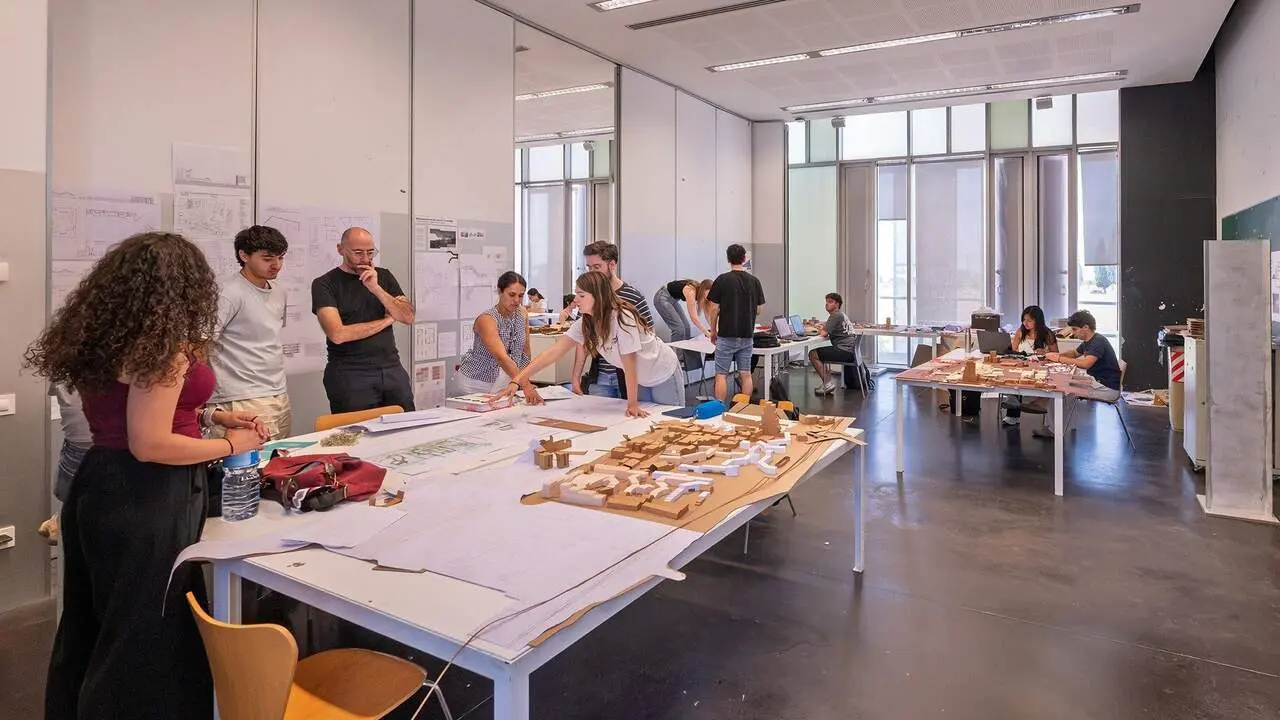

The current model of university classrooms limits participation and collaborative work. Rovira i Virgili University proposes a radical change: flexible spaces that adapt to different methodologies and integrate technology functionally.
You may have wondered why many university classrooms seem taken from another era? The answer is not only architectural but pedagogical and technological. Here is the key to understanding how to change it.
The role of space in university learning
What does a flexible space bring to students?
Traditional university spaces are based on a unidirectional model where the teacher transmits knowledge and students passively assimilate it. This model is manifested in classrooms with fixed furniture, oriented towards the blackboard or screen, and with technology resources that are not very versatile. Jordi Duch, researcher at the Department of Computer Engineering and Mathematics of the URV, points out that this rigidity limits the possibility of more participatory and collaborative activities.
In contrast, a flexible space allows students to actively participate in the learning process. The classroom becomes an environment where dialogue and collaboration are possible, facilitating methodologies focused on participation and teamwork. Thus, the space is not just a container but an active agent that conditions the way learning takes place.
How do physical conditions influence methodologies?
URV research highlights that elements such as the shape of the classroom, type of furniture, lighting, acoustics, and technology resources are not merely decorative or functional details, but have a direct impact on the methodologies that can be developed there. A rigid space tends to favor only a vertical relationship between teacher and students, while reconfigurable and technological spaces open the door to more complex processes such as analyzing, evaluating, or creating.
Mercè Gisbert, from the Department of Pedagogy, points out that architecture alone does not guarantee positive educational results. Learning is the result of a dynamic interaction between people, methodologies, space, and technology. Therefore, a traditional space can expand its possibilities if flexible digital tools are integrated, and conversely, an innovative space can fail if not used with clear pedagogical objectives.
Incorporation of technology and student participation
How is technology integrated without complicating things?
Researchers advocate for an "invisible integration" of technology: it should be present without attracting attention or generating additional burden for teachers or technical services. Jordi Duch explains that easy-to-use systems, compatible with each other and non-distracting, are key so that all attention focuses on learning.
This technology can range from interactive digital whiteboards to immersive environments or platforms that allow real-time interaction. Generative artificial intelligence is also included, which can personalize training paths, offer immediate feedback, or support evaluation. All this, provided it is implemented in an accessible way and consistent with educational activities.
Why is student participation in design key?
Much of the campuses have been designed from the perspective of teachers and management, which has favored lecture-based classrooms and individual offices while lacking open and reconfigurable space. Roger Miralles, from the Higher Technical School of Architecture, highlights that involving students in the design process helps identify real needs, avoid errors, and adapt spaces to diverse ways of learning.
Additionally, the redesign must take into account the diversity of origins, abilities, and trajectories of students. Accessibility and inclusion must be present from the beginning, with ergonomic furniture, adjustable lighting, wide accesses, and support technologies for motor, sensory, or cognitive needs. It is also proposed to integrate the gender perspective to avoid reproducing inequalities in the use of spaces and resources.
Organizational changes and practical proposals for transformation
What organizational challenges does classroom adaptation entail?
Space transformation is not limited to changing tables or installing screens. Flexible spaces may require new reservation systems, trained staff to adapt classrooms, and teachers being able to configure them autonomously. The authors emphasize that a cultural change is needed: moving from maximizing occupancy to seeking the most appropriate configuration for each activity.
This change should be applied on three levels: the classroom and teaching practice, programs and departments, and finally university policies and infrastructures. Coordination among these levels is key to ensuring that changes are effective and sustainable.
How to start transforming classrooms without large investments?
Researchers agree that it is not necessary to wait for large budgets or new construction to start the transformation. Small-scale interventions, such as reorganizing furniture, making use of corridors, common areas, or outdoor spaces, and incorporating simple technological tools can generate significant improvements.
These actions allow universities with architectural and budgetary limitations to begin moving towards environments more favorable for active and collaborative learning. What really matters, according to the study, is to put pedagogy and people's needs at the center of design, beyond physical infrastructure.
| Aspect | Traditional model | Flexible model |
|---|---|---|
| Furniture | Fixed, oriented to the blackboard | Reconfigurable, adaptable to groups and activities |
| Technology | Limited or conventional | Integrated, easy to use and compatible |
| Participation | Unidirectional (teacher-student) | Collaborative and interactive |
| Accessibility | Limited | Including ergonomics, adjustable lighting, and support for diversity |
| Management | Static space allocation | Flexible reservation systems and autonomous adaptation |
Source of the article: Rovira i Virgili University