The book that explains Tarraco like never before, with technology and rigor
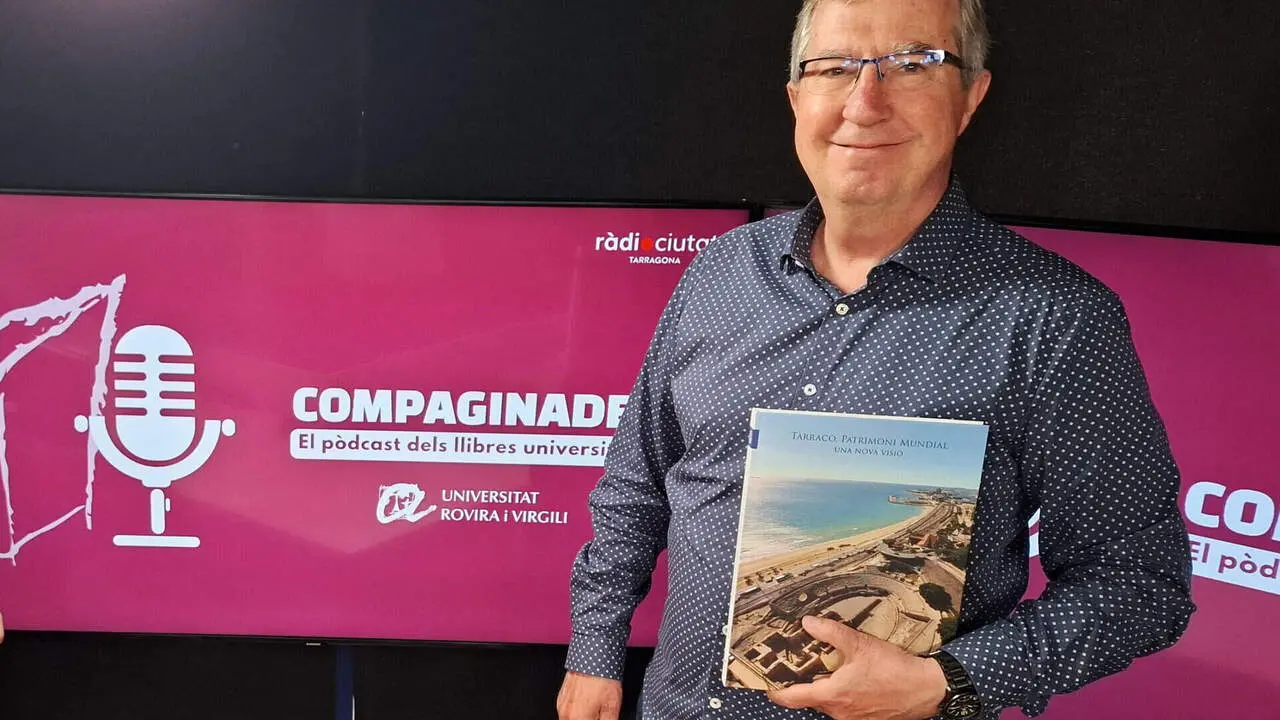

Tàrraco speaks again, but now it does so with images that almost jump out at you and a gaze that wants to reach everyone. It is not just any book: it is the new vision of Roman heritage promoted by the Rovira i Virgili University, which connects the most advanced research with the public.
Published by the archaeologist Joaquín Ruiz de Arbulo, this book coincides with the quarter-century anniversary of Tàrraco’s declaration as a World Heritage Site by UNESCO, and promises to change the way we understand the Roman monuments in Tarragona and its surroundings.
A university book that speaks clearly and with images
A groundbreaking format
Jaume Llambrich, coordinator of URV Publications, describes the work as “unique” for several reasons. The format is designed so that everyone can understand the archaeological remains thanks to plans and 3D restitutions, which make monuments often difficult to read in plan view much more accessible.
Moreover, the book is not a compendium of experts locked behind closed doors: it translates decades of research into clear language, without losing the scientific rigor demanded by archaeology.
Outreach that does not give up rigor
According to Ruiz de Arbulo, dissemination is not lowering the level, but the effort to make complex concepts understandable. It does not aim to close the history of Tàrraco, but to place the reader exactly where the research stands today: the “end of the beginning” for understanding what these monuments really were and what they really meant.
This requires a delicate balance between science and narrative, which the book achieves thanks to the collaboration between experts and editors who know how to bring information to everyone.
The heritage that unites Tarragona, Constantí, Altafulla and Roda de Berà
A territorial view beyond the city
The route is not limited to the city of Tarragona. The book includes archaeological sites from Constantí, Altafulla, and Roda de Berà, showing that Roman heritage is a shared legacy that must be explained as a coherent whole. This perspective broadens the cultural identity of the Camp de Tarragona.
Thus, the heritage does not remain trapped in a tourist postcard, but becomes a living element that strengthens the social fabric and the image of the territory.
Reinforcing cultural and tourist identity
With this global vision, the URV positions the area as a cultural and tourist reference that not only shows ancient stones but explains their social, symbolic, and political function. In short, it provides the nuances that most cultural offerings fail to convey.
The book is therefore a tool to connect residents and visitors with a heritage that is often only seen superficially.
Between paper and digital: a debate that still smolders
The value of the paper book today
In the midst of the digital age, Ruiz de Arbulo advocates for the coexistence of formats. Paper, he says, guarantees long-term memory and allows for deep and lasting reading. In contrast, the digital world is immediate but much more fragile, raising questions about the future preservation of knowledge.
Thus, the university book not only competes but complements the digital edition, offering support that time does not blur.
URV Publications: more than a publisher
URV Publications not only prints books but assumes a key social role: bringing research to the community, fostering cultural debate, and strengthening the link between university and territory. Tàrraco. World Heritage. A new vision is the best example of this mission.
The project shows that a university book can be rigorous, attractive, and useful for any reader, from the professional to the curious who wants to know what Roman Tarragona hides.
The reality is that the way we explain heritage can change the perception we have of it, and this work has laid the first stone of a more accessible and vibrant discourse.
Source of the article: Rovira i Virgili University