‘Déu-n’hi-do’, ‘badar’ and ‘biaix’: the words that triumphed on Diccionari.cat in 2025
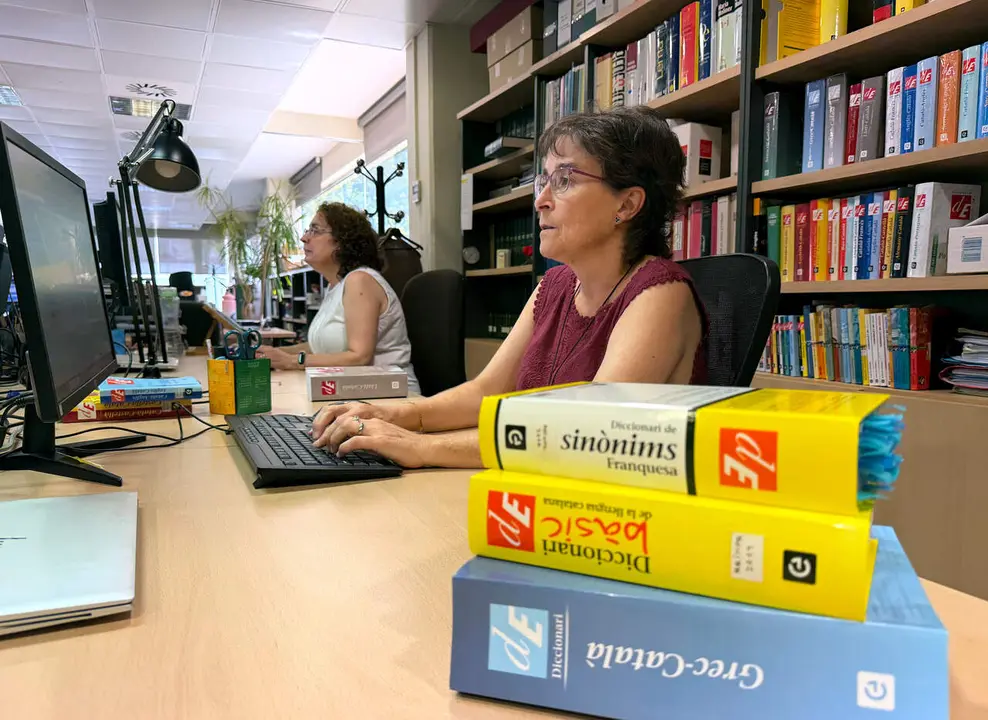

The words ‘déu-n’hi-do’, ‘badar’ and ‘biaix’ top the queries on Diccionari.cat, with 7 million annual users. This pioneering service, created in 1998, remains a benchmark despite growing digital competition, including artificial intelligence.
What drives these millions of queries? The answer is not as simple as it seems, and hidden within are orthographic doubts, new usages, and the constant search for linguistic rigor. Moreover, there is another protagonist: Enciclopèdia.cat, which keeps historical knowledge alive with 2.5 million annual visits.
Diccionari.cat: more than an online dictionary
Which words are the most searched and why?
Núria Bord, head of dictionary editing at Enciclopèdia Catalana, explains that the most consulted words in the Gran diccionari de la llengua catalana (CDLC) in 2025 and the early months of 2026 are ‘déu-n’hi-do’, ‘senyal’, ‘anàlisi’, ‘compte’, ‘provar’, ‘comptar’, ‘badar’, ‘corrent’, ‘biaix’ and ‘il·lusió’.
These terms can be classified into four groups: words with orthographic difficulties (such as déu-n’hi-do), terms with grammatical doubts (‘un anàlisi or una anàlisi’), new words with more frequent uses (‘biaix’ due to the increase in discussion about gender or AI bias), and vocabulary less common among students (‘badoc’, ‘baliga-balaga’).
Why does Diccionari.cat remain indispensable?
People consult Diccionari.cat because they feel insecure with the language, whether learning it or due to orthographic and grammatical doubts. There are also those who do it out of curiosity or for language games, in addition to professionals and students.
With 7 million annual visits, the service faces fierce competition, especially from artificial intelligence. Núria Bord highlights that although AI has slightly reduced queries, it also uses Diccionari.cat as a source and cites its data, an investment that reinforces the value of the service.
Enciclopèdia.cat, an encyclopedia that never stops evolving
What are the most consulted contents and why are users interested?
Enciclopèdia.cat focuses on content, not just meaning. The History of Catalonia leads the searches, with articles about Jaume I, the Segadors war, and the Catalan-Aragonese crown. Topics in humanities, science, geography, and general culture also stand out, such as the ‘zodiac sign’.
Marga Prades, head of Enciclopèdia.cat, emphasizes that it is a “living encyclopedia” that is continuously updated, adapting historical content to the present and maintaining an editorial team that permanently reviews and edits.
How are these digital resources kept alive?
Users play an active role, sending queries and comments via forms. This strengthens the community and improves the quality of the contents.
With the 60th anniversary of the Gran Enciclopèdia Catalana celebrated in 2025, and more than 25 years since the first digital version (1997), Enciclopèdia.cat is today the main avenue of updates, since it has not been reissued in physical form since 2012.
Digital value and the Catalan perspective
What is the importance of the local and rigorous vision?
Marga Prades argues that these portals are key to making Catalan culture and knowledge of the language easily accessible to everyone. They are rigorous sources, validated by specialists and with their own perspective, different from the Anglo-Saxon or peninsular viewpoint predominant on the internet.
How does artificial intelligence impact these services?
AI, more than a threat, is an ally that uses Diccionari.cat as a reference for its answers and, at the same time, slightly reduces the volume of direct queries. The Diccionari.cat team sees opportunities to grow, improving web functionalities and expanding its dictionary offerings to attract new users.
| Word | Type of query | Main reason |
|---|---|---|
| Déu-n’hi-do | Orthographic difficulty | Complexity in the use of the combination |
| Badar | Uncommon vocabulary | Word unknown to students |
| Biaix | Growing use and current relevance | Debate on gender and AI bias |
| Senyal | Grammatical doubts | Confusion on feminine or masculine use |
Source of the article: Pau Cortina / Catalan News Agency