The total solar eclipse on August 12 will be broadcast live from the Ebre Observatory
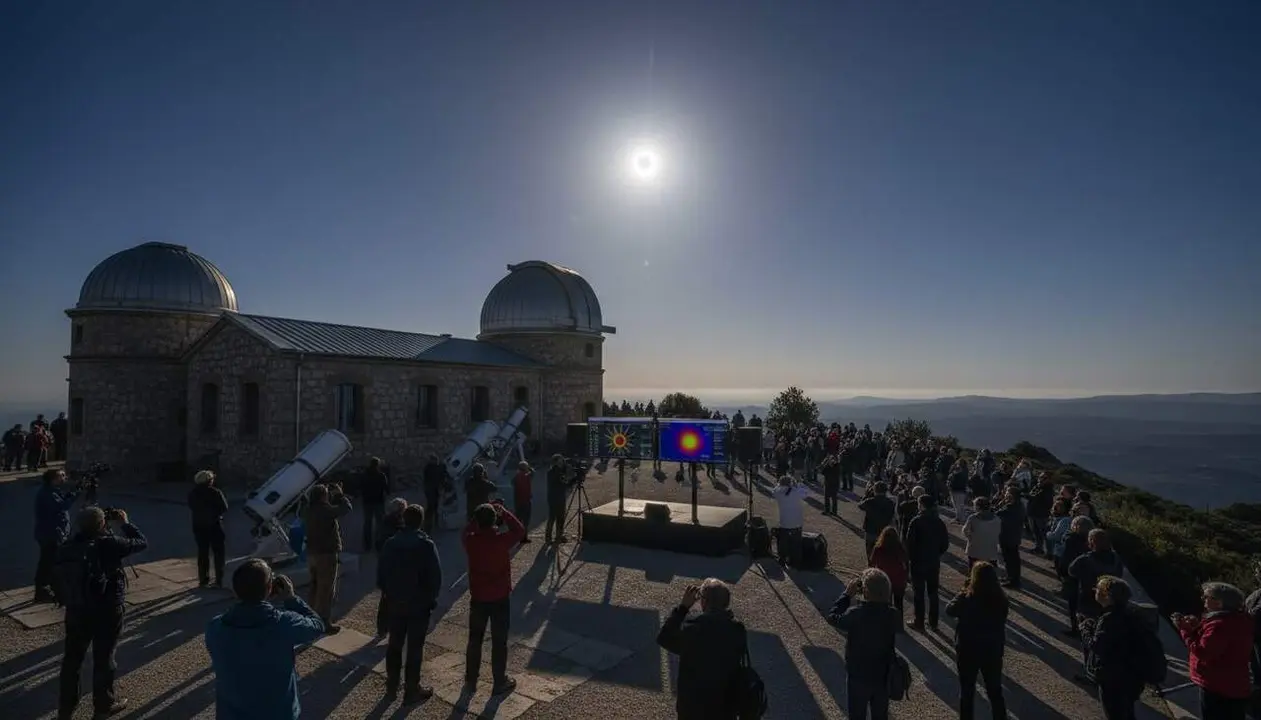

The Government will broadcast live the total solar eclipse on August 12 from the Ebre Observatory, in Roquetes, the only place in Catalonia where totality can be seen. This astronomical event will begin at 7:36 p.m. and reach its full phase at 8:30 p.m., during one and a half minutes of celestial fascination.
In addition, the programming includes lectures by key figures such as Didier Queloz, Ellen Baker, and Pedro Duque, who will bring their scientific and space perspectives before the culminating moment. This is not just a broadcast, but a unique educational and scientific experience in Baix Ebre.
The Eclipse Day at the Ebre Observatory: What Will Happen and Why It Matters
What will happen on August 12 at the Ebre Observatory?
On August 12, the day will start at 12:30 p.m. with institutional speeches, followed by scientific lectures beginning at 4:00 p.m. When the eclipse starts at 7:36 p.m., the live broadcast will show the different phases in real time until totality at 8:30 p.m.
Why is the Ebre Observatory the chosen setting?
The Ebre Observatory is no ordinary place: it is the only observatory located in the path of totality in Catalonia and has more than one hundred years of history in studying the relationships between the Sun and the Earth. Its location and scientific value make it the ideal point for this event.
Lectures and Prominent Scientists: What Will They Bring to the Broadcast?
Who are the scientists and astronauts participating?
The day will feature the presence of Didier Queloz, Nobel Prize in Physics; Ellen Baker, NASA astronaut and physician; and Pedro Duque, the first Spanish astronaut and president of Hispasat. There will also be experts such as Pavel Gabor, Teresa Nieves-Chinchilla, Salvador J. Ribas, Juan José Curto, and Ignasi Ribas.
What topics will be covered in the lectures?
The talks will address topics such as the legacy of great observatories, life beyond Earth, challenges of space exploration, the search for other worlds, and space weather. Before the eclipse, the phases and phenomena that can be observed will be explained.
Scientific Experience and Observation: What Will the Audience Be Able to See and Learn?
How can the eclipse be followed and what will be observed?
The broadcast will be done through the YouTube channel of the Department of Research and Universities, covering the phases of the eclipse and phenomena such as the solar corona and the sudden darkening of the sky during totality, which will last approximately one and a half minutes.
What experiments and activities are included during the day?
The Meteorological Service of Catalonia will launch three weather balloons with radiosondes to study how the drop in solar radiation affects variables such as temperature, humidity, pressure, and wind at different altitudes. This data will provide information on space weather in real time.
Minister Núria Montserrat has highlighted that the broadcast will allow anyone, even those who cannot travel, to experience this historic moment, in addition to encouraging interest in science and research.
The project is part of ‘Catalonia Looks at the Sky,’ an initiative to promote scientific culture and vocations in astronomy and space, with the collaboration of the Ebre Observatory and the Montsec Astronomical Park.
The reality is that this broadcast will not only be a visual event but an educational and scientific window that will connect the community with the firmament in a way rarely seen in Catalonia.
Source of the article: Catalan News Agency