Musk’s surprising plan: 119 billion for the AI chip factory
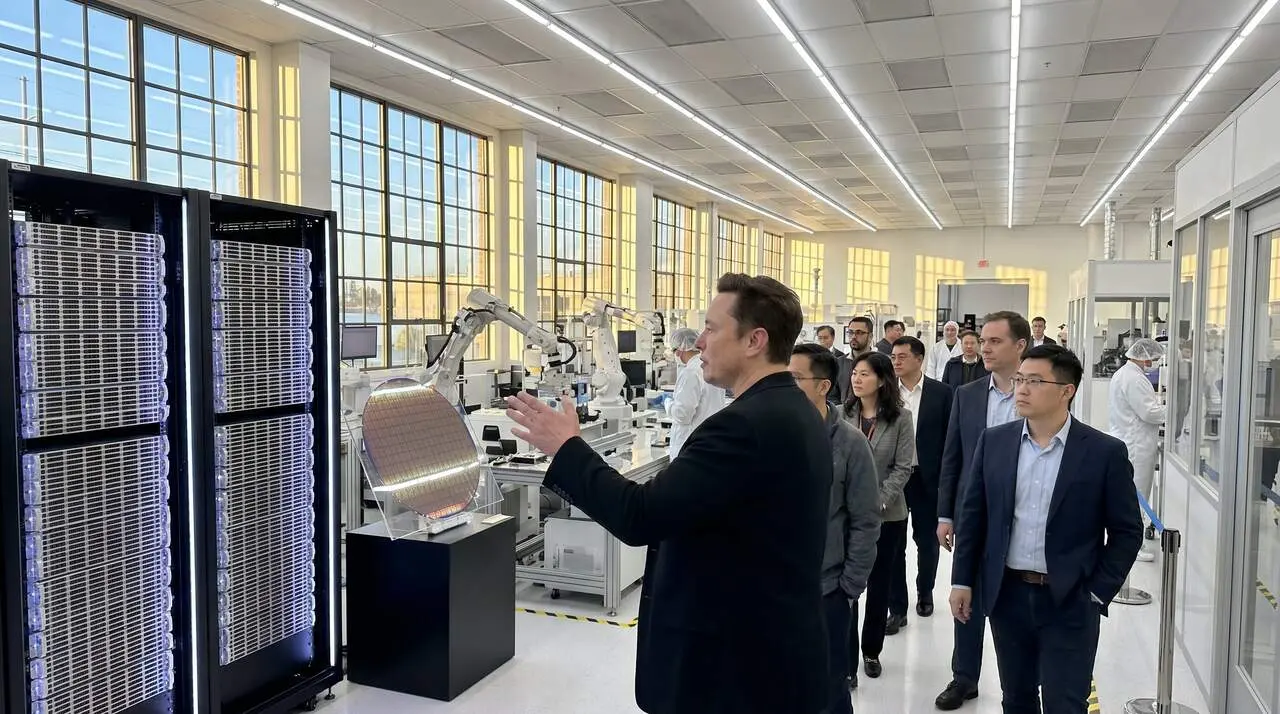

Imagine a project capable of transforming the entire artificial intelligence chip industry on a global scale. This is precisely what Elon Musk is driving with his mega investment of up to $119 billion in Texas. An ambitious move that could change the future of technology.
This bet is no small matter: it is Terafab, a cutting-edge chip manufacturing plant that promises to integrate the entire production chain into a single complex, with a focus on the next revolution in AI and robotics.
The Terafab Project: an ambitious megafactory in Texas
The investment and scaled development
The initial plan includes an investment of $55 billion, but the figure could rise to $119 billion if all the planned phases are completed. Musk wants SpaceX to lead this construction, with a plant that not only manufactures chips but also performs advanced processing and packaging in an integrated vertical structure.
This vertical integration is uncommon outside Asia, and will allow the manufacturing of between 100 billion and 200 billion customized chips per year, a figure impressive for its scope and industrial capacity.
Intel and the collaboration to accelerate production
Intel has recently joined the project, bringing its expertise in design, manufacturing, and large-scale packaging. The goal is to accelerate Terafab’s capacity to reach an annual production of 1 terawatt (TW), a volume that opens the door to significant advances in AI and robotics.
With 2-nanometer technology at the forefront, this industrial complex will integrate logic processing, memory, and advanced packaging, marking a before and after in chip manufacturing.
The AI5 chip and future applications
The technological heart of Terafab
The flagship development will be the fifth-generation AI5 chip, designed to power complex systems like autonomous driving, Cybercab robotaxis, and Optimus humanoid robots. Musk is not content with manufacturing; his goal is to control the entire chain, from pilot production planned for 2026 to full industrial scale the following year.
This chip will be the key for Tesla and its technology divisions, integrating high-power processing with memory and other components into a single ecosystem.
Global positioning and competitive advantages
If Terafab achieves its goals, Tesla will be one of the few companies outside Asia with its own capacity to manufacture AI chips at a large scale. This will strengthen the infrastructure of the Dojo supercomputer and Musk’s AI division, xAI.
This technological autonomy translates into a clear competitive advantage, avoiding dependence on imported chips and anticipating possible future shortages.
Strategic collaborations and new frontiers in computing
Alliance between SpaceX and Anthropic
Coinciding with the Terafab announcement, SpaceX and Anthropic have formalized an alliance to expand data processing capacity, responding to the growing demand for AI-based services. Anthropic will have immediate access to SpaceX’s Colossus 1 data center, increasing computing power by 300 megawatts in the short term.
This strategic collaboration shows a clear commitment to boosting the infrastructure necessary for future AI developments.
Orbit computing: the new frontier
Anthropic and SpaceX are also exploring the creation of AI data centers in orbit, aiming to reach several gigawatts of computing power. This revolutionary initiative could improve the efficiency and scalability of data processing, opening new possibilities in distributed computing beyond Earth.
Beyond this innovation, Musk has confirmed that xAI is integrating as SpaceXAI, a unification that strengthens SpaceX’s AI division and its technological leadership.
The reality is that with Terafab, Musk does not just want to manufacture chips; he is preparing the ground for the next era of artificial intelligence and robotics, with a colossal and well-calculated bet.