Startup presents chocolate with cocoa butter cultivated in a laboratory

In the chocolate market, we often see promises and glamour, but rarely a real technological leap. A startup has managed to produce cocoa butter from a single seed, without the need for fields or trees.
But what does this mean for the industry and for us, chocolate lovers? A drastic change that still raises doubts, both about flavor and environmental and social impact.
Chocolate with lab-grown cocoa butter: the revolution of Celleste Bio
🕐 Year of launch: 2026
💶 Expected market: coming years
🍽️ Product: chocolate with cell-cultured cocoa butter
A technological leap that is not just a gimmick
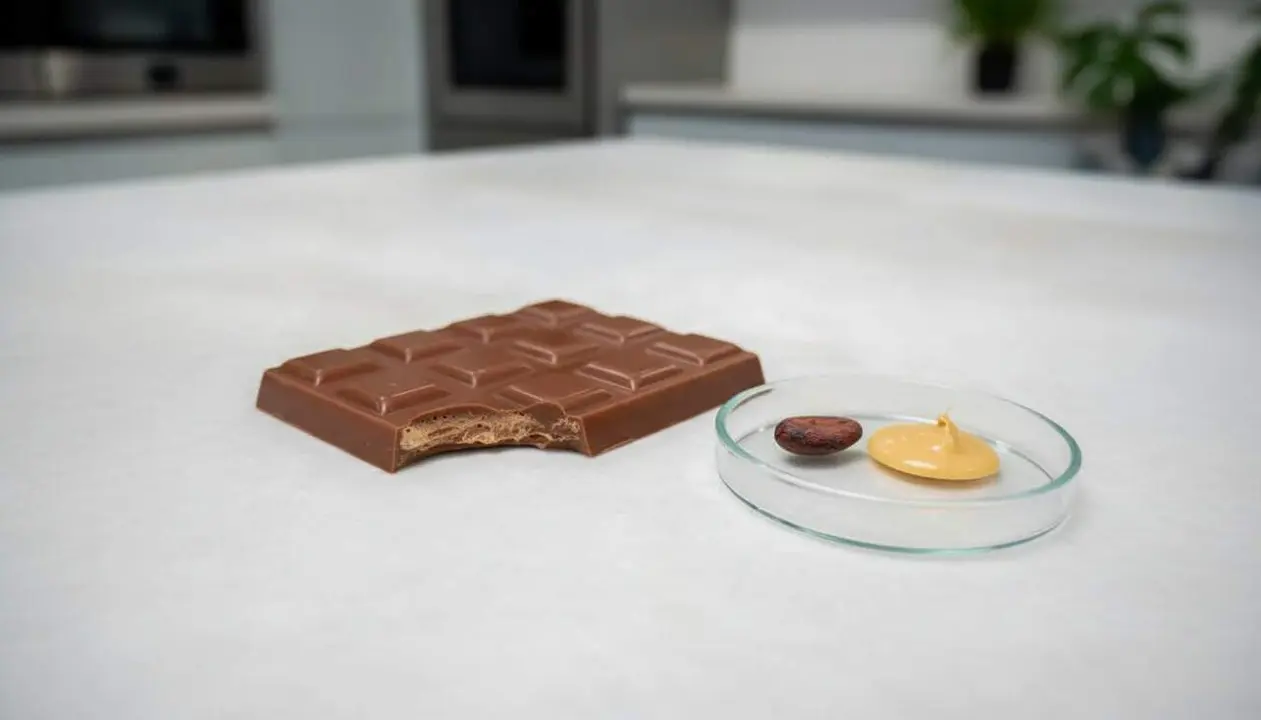
Celleste Bio does not make chocolate just any way. Their secret lies in cocoa butter cultivated in bioreactors from a single seed, exactly mimicking the texture, flavor, and characteristic crunch of traditional chocolate. It’s not just a scientific curiosity: it’s a bet to redefine the production of one of the most complex and valued raw materials.
From seed to bioreactor: how does this magic work?
Instead of planting trees and waiting years, Celleste cultivates plant cells in suspension inside bioreactors. These cells are fed with nutrients and oxygen controlled by computer, allowing a stable and predictable production, free from pests and climate changes.
Additionally, the technology incorporates artificial intelligence and computational modeling to adjust the melting point or sensory profile, turning chocolate into a kind of gourmet engineering.
Impact and challenges in the industry and the environment
The global context of cocoa and the need for change
The cocoa sector has suffered the consequences of climate change, diseases, and price volatility, especially in countries like Ivory Coast and Ghana. That is why this laboratory cocoa butter production does not aim to replace traditional cultivation but to act as a complement that stabilizes the market.
Traceability improves radically with each batch traceable from its cellular origin, eliminating usual uncertainties of agricultural processes.
Environmental aspects: between advantages and warnings
Reducing the need to expand plantations means less deforestation in tropical areas, one of the major troubles of the sector. It also consumes less water and requires no fertilizers or pesticides.
But it’s not all a fairy tale: laboratory production consumes energy that can be high. If this energy is not renewable, the ecological impact could be less positive than it seems. The balance depends heavily on integration with sustainable energy systems.
Future perspectives and transformation of the food model
From innovation to market: industrial challenges
Companies like Mondelēz already show interest in this technology that promises stable and adaptable raw materials. Chocolates that better withstand heat, new textures, and unique experiences could become the new norm.
The main challenge is scaling production to competitive industrial levels, but Celleste Bio is already advancing towards relevant volumes in the coming years.
A global cultural and food change
Cocoa enters a broader conversation about resilient food systems, alongside cultivated meat and alternative proteins. As a global and cultural product, chocolate carries symbolic weight that makes this shift not only technical but also social.
For chocolate lovers, the future may be as sweet as it is puzzling.
The reality is that the lab-grown cocoa butter revolution could be the key to more stable and sustainable production, but the energy it consumes and social acceptance will determine its true dimension.