Sant Jaume d’Enveja revives a Grandmothers' Rice with 20 participants
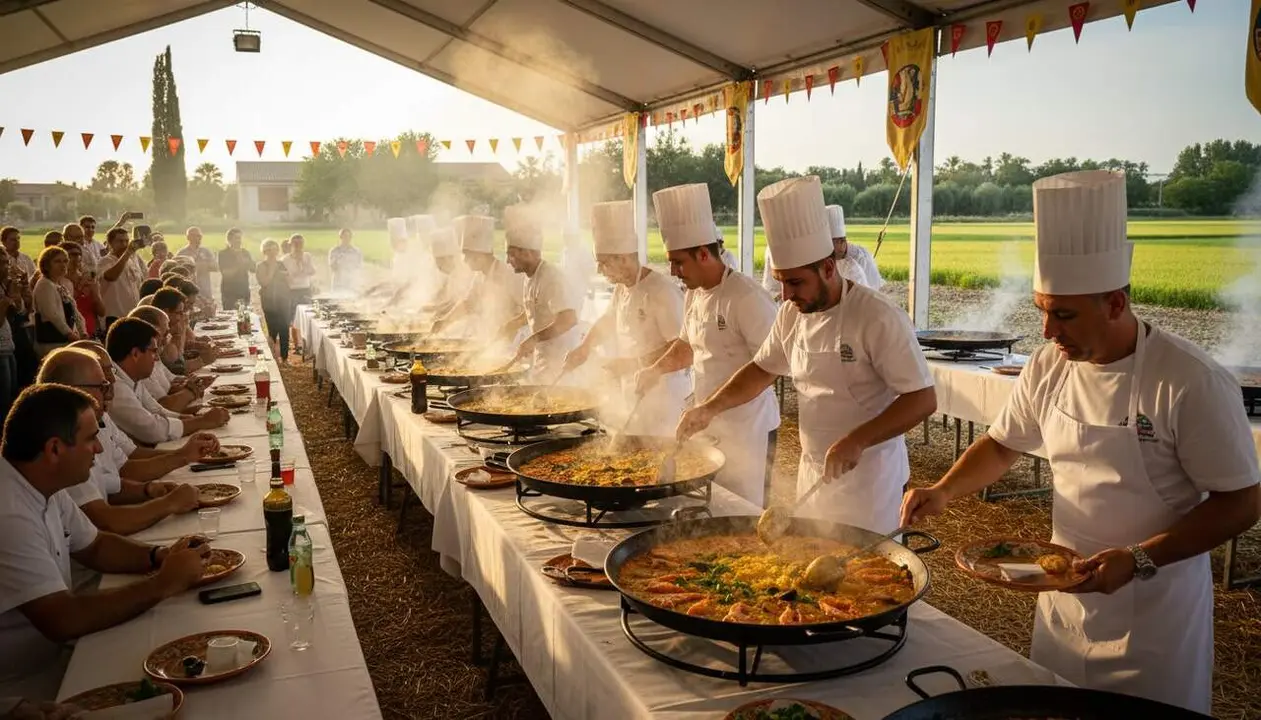

The second edition of the Sant Jaume d’Enveja National Rice Contest brought together about twenty participants to revive a traditional Delta recipe. Everyone cooked with the same ingredients and just over an hour and a half to prove that rice can take many forms.
At the old facilities of the Rice Chamber, the smell of the sofrito served as a clock. Meat, vegetables, apron, and hurry: a scene of popular cooking turned competition, with the memory of the grandmothers and grandfathers of the Delta on every table.
A Contest with a Recipe Returning to the Tables
Why does Sant Jaume d’Enveja revive this Rice?
Because the recipe is part of traditional Delta cooking and had been fading away. The contest puts it back at the center of a public activity, with participants who had to reproduce it within a limited time and in front of a jury.
It is not just about preparing a dish and waiting for the verdict. The proposal aims to keep alive a gastronomic heritage passed down for years in the homes of the Delta, where recipes usually do not come with exact measurements or laminated instructions.
Noelia Balagué, president of the DOP Arròs del Delta, explained that they are recovering “a lost recipe that grandmothers made many years ago.” The phrase summarizes the human angle of the contest: behind each dish there is a family memory that now passes through the stoves of a national competition.
Same Ingredients, Very Different Results
The contestants started with the same ingredients, but the rice dishes did not end up identical. The jury had to evaluate the cooking point, taste, presentation, and texture of each preparation.
This difference is precisely one of the charms of traditional cooking. The base can be shared, but the fire, the time, and the hand of the cook end up leaving a personal imprint. The recipe can be the same; the result, not so much.
With just over an hour and a half to work, the participants had to make quick decisions and turn a common list of ingredients into a rice dish capable of convincing the jury. The hurry was there, but the dish required control.
Twenty Participants and a Community Around the Stoves
Who Participated in the Contest?
The event brought together about twenty participants, including neighbors from Terres de l’Ebre and Valencian contestants. Laura Garcia, from Roquetes, debuted with her partner and defended the value of preserving culinary traditions.
“It is important to maintain the tradition, to create unity and community,” Garcia expressed to ACN. Her participation shows that the contest is not limited to professional cooks nor a display of technique: it is also a space for neighbors to share what they have learned at home.
Among the participating pairs were Francesc and Paquita, from the Valencian Community, who won the contest’s first prize. The result adds a territorial dimension to the day: rice cuisine connects the two cultural banks that share traditions and ways of preparing it.
What Is at Stake Beyond the Prize?
There is the continuity of a way of cooking and the recognition of an ingredient that identifies the Delta. There is also a very concrete idea: the local product needs people to value it, buy it, and pay for it, not just to appear in speeches.
Joan Gòdia, General Director of Agri-food Companies, Quality, and Gastronomy, described DOP-certified rice as “a treasure that we must conserve and preserve.” The DOP, he emphasized, represents origin and quality.
That is why the contest works as a public demonstration of the value of the product. It is not a decorative label: it identifies a provenance and places Delta rice at the center of an activity that the public can see, taste, and judge with their own criteria.
Moreover, Delta cuisine does not live apart from the territory that produces it. When a recovered recipe is cooked in an old rice chamber, the dish tells where it comes from before anyone has tasted the first spoonful.
The Harvest Route Places Rice at the Center of Terres de l’Ebre
How Is the Contest Integrated into the Harvest Route?
The contest is part of the rice harvest route, a proposal that distributes activities among seven municipalities of Terres de l’Ebre. This expands the reach of the day and turns the contest into a piece of a program dedicated to an emblematic product of the Delta.
The route allows relating cuisine, territory, and rice-farming activity without separating them into compartments. The contest puts the dish on the table; the harvest explains the work behind the rice arriving in the kitchen.
For the region’s reader, the detail matters: it is not about an abstract gastronomic activity, but a route involving seven municipalities of Terres de l’Ebre that claims a production known in the homes of the territory.
What About the Rice Harvest?
The entry of bomba rice into the rice chambers has already been completed. Noelia Balagué explained they are very happy with the yields and estimate that in approximately one week they will begin to fully harvest the rest of the varieties.
This information places the contest within a specific moment of the rice calendar. While the pairs cooked a traditional recipe, the agricultural cycle advanced, with rice entering the chambers and harvesting other varieties increasingly near.
The link with fresh product also helps understand why local gastronomy is not a matter of decoration. The final dish depends on a chain that begins in the territory, continues with the harvest, and reaches the table through a product with a seal of origin.
The day leaves a simple and powerful image: twenty people cooking with the same ingredients, a jury watching the rice doneness, and a grandmother’s recipe reclaiming space. In times of quick recipes and dishes that seem to come from a catalog, the Delta asserts another pace: that of fire, memory, and taste.
The Sant Jaume d’Enveja National Rice Contest has united traditional cuisine, local product, and rice farming activity in one day. The recovered recipe, the participation of neighbors from Ebre and Valencia, the first prize for Francesc and Paquita, and the harvest route tell a story beyond a winner: keeping alive what gives identity to Delta cooking.
Frequently Asked Questions
- How many participants were in the rice contest?
- About twenty participants competed in Sant Jaume d’Enveja in the second edition of the National Rice Contest organized by DOP Arròs del Delta.
- What recipe did they have to prepare?
- The contestants prepared a recipe belonging to traditional Delta cuisine, recovered because grandmothers from the area made it many years ago.
- Who won the first prize?
- The couple Francesc and Paquita, from the Valencian Community, were declared winners of the contest.
- What did the jury evaluate?
- The jury considered the cooking point of the rice, taste, presentation, and texture of the dishes.
- Where is this activity framed?
- The contest is part of the rice harvest route, which distributes activities among seven municipalities of Terres de l’Ebre.
Source of the article: Ariadna Escoda Padilla / Catalan News Agency