Egg prices at Mercadona, Carrefour, and Alcampo: what will you pay in 2026?
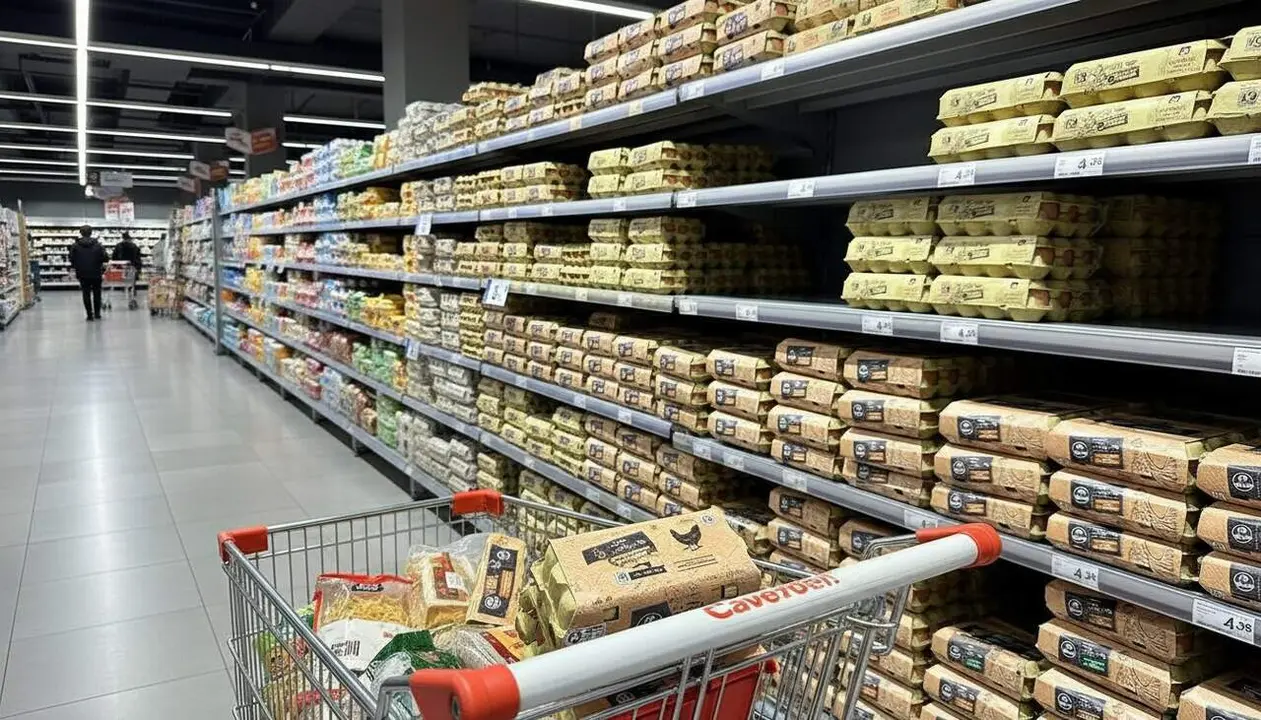

Eggs continue to be an essential product in the Spanish shopping basket, along with milk and olive oil. A dozen fresh eggs are almost never found below three euros in most supermarkets, although Alcampo maintains some references below this threshold.
Sources from FACUA-Consumers in Action, through their portal super.facua.org, confirm that as of May 26, 2026, prices remain stable at Mercadona, Carrefour, Alcampo, Dia, Hipercor, and Eroski. This stability is not accidental but the result of a market that has found a ceiling after a sustained rise in recent years.
Current egg prices in major supermarkets
💶 Average price per dozen: between €2.27 and €4.28
🕐 Stability: no changes since April 2026
🍽️ Varieties: class M, L, XL and free-range eggs
Mercadona and Alcampo: stability and competition
Mercadona keeps the dozen medium eggs (M) at 3 euros and the large eggs (L) at 3.20 euros, without moving prices for a month. Alcampo stands out with its lowest price for a dozen class L eggs at 2.27 euros, a reference that has not changed since April.
The difference between the two chains is clear: Alcampo offers the cheapest fresh egg while Mercadona maintains the most consistent offer in specialized varieties such as XL or free-range eggs, which can exceed 4 euros per dozen.
Carrefour, Dia and Hipercor: prices that do not fall
Carrefour presents the most expensive dozen large eggs (L), at 4.28 euros, after a rise that arrived in 2025 and has not retreated. Free-range eggs at Carrefour remain at 3.20 euros, as in Dia, where the dozen fresh M and L eggs stay between 3.10 and 3.30 euros.
Hipercor (El Corte Inglés) has also not changed its prices: class M is at 2.99 euros and L at 3.29 euros. This stability is repeated at Eroski, with prices similar to those of Dia for the same categories.
Context and factors that have driven the price rise
The perfect storm: avian flu and energy costs
The General Director of Consumption, Antonio Rodríguez Lázaro, defines the egg situation as a “perfect storm.” The increase in production and energy costs, added to the avian flu that forced the sacrifice of more than 16 million hens, shot prices up in 2023.
Moreover, the shift toward free-range hens, which requires investments up to four times greater in facilities, has kept prices above pre-crisis levels.
Stabilization during 2026 and recent comparison
Between April and May 2026, egg prices have remained practically unchanged, with a mix of slight occasional drops and general stability at the major chains. This high price plateau reflects the new normal of the market.
FACUA data indicate that no chain has significantly reduced rates and that consumers must accept that eggs will cost more compared to three years ago, when the dozen was clearly below three euros.
Tax and local price particulars
Types of VAT and impact on final price
Eggs are taxed at the super-reduced rate of 4% since they are a basic staple food. During the 2022-2024 price crisis, this tax temporarily dropped to 0% to contain the shopping basket cost, but it has returned to 4% since 2025.
This measure helped limit even greater increases but has not reversed the sustained accumulated rise.
Variability depending on location and references
Prices collected by FACUA come from official websites without postal codes added, so they may vary slightly depending on the supermarket’s location. Nonetheless, the general trend is clear: prices remain high and constant.
Consumers wishing to compare prices can check the price of different chains to find the option best suited to their budget.
It is also interesting to note how in 2026 price levels remain at what is already considered the base after the crisis, with no sharp changes in sight. This fact is key for family shopping planning.
By the way, if you are curious about other basic products, you can consult the comparison of the 2026 prices that are setting trends in other sectors.
In summary, the price of eggs at Mercadona, Carrefour and Alcampo reflects stabilization in a market that has learned to live with the highest price in its recent history and seems willing to maintain this situation in the short term.