Piedmontese salad: the Italian secret behind Russian salad

At the market, among stalls full of colors and scents, it is not unusual to come across dishes that seem familiar but hide small unexpected gastronomic stories. This happens with a recipe that, despite its simple appearance, conceals an Italian past that many are unaware of.
A few weeks ago, at a discreet yet characterful Italian restaurant, I rediscovered a salad that made me think of Russian salad, but with its own air and a personality that you don't find on every menu. This salad is the famous Piemonte salad, and its charm lies in the combination of classic ingredients with a distinctive touch that only Piedmontese cuisine knows how to offer.
Origin and uniqueness of the Piemonte salad
An Italian classic with its own essence
The Piemonte salad comes from northern Italy, specifically from the Piedmont region, known for its hearty but balanced cuisine. This recipe has become established as a variant of the traditional Russian salad, but with ingredients and flavors that give it a more Mediterranean character and a lighter feel than the Spanish version.
Chef Mario Bianchi, an expert in regional Italian cooking, commented in 2022 that “the Piemonte is a dish that reflects the sophisticated simplicity of northern Italy, where the freshness of tomatoes and the texture of potatoes combine with a hint of mustard that makes the difference.”
Key ingredients and their role
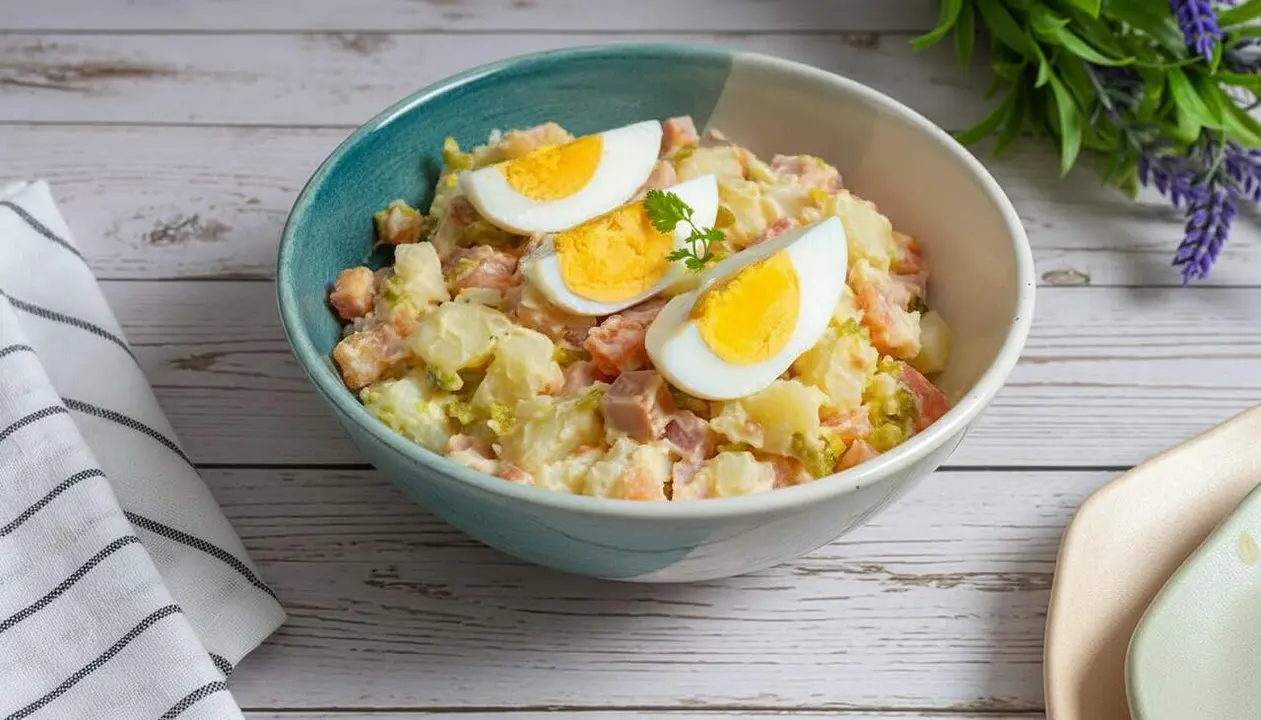
The basic components of the Piemonte salad are: potatoes cooked in cubes, fresh tomatoes, hard-boiled egg, diced cooked ham, and small pieces of pickled gherkin. The sauce accompanying this mix is an emulsion of mayonnaise and Dijon mustard, which adds a slightly tangy and creamy touch that balances the sweetness of the ham and the freshness of the tomatoes.
The delicacy of the dish lies in its balance and the texture it generates, where each bite combines the softness of the potato, the slight crunch of the gherkin, and the intense yet delicate flavor of the special sauce.
Step-by-step preparation of the Piemonte salad
Preparing the ingredients
To start, you need to peel and boil the potatoes for about 10 minutes in salted water, until tender but not too soft, and cut them into cubes. The eggs, also boiled for 10 minutes, are cooled in ice water to make peeling easier and then quartered.
The tomatoes are washed and diced, while the cooked ham is cut into pieces similar in size to the potatoes to maintain a homogeneous texture. The pickled gherkins are finely chopped to add a touch of freshness and slight acidity.
The final touch and presentation
The mayonnaise is mixed with Dijon mustard until a creamy, homogeneous sauce is achieved. Next, everything is combined in a large bowl, incorporating potatoes, ham, tomatoes, and gherkins, and the sauce is added to bind the dish. Finally, it is garnished with the hard-boiled egg quarters and salted to taste.
The result is a fresh, flavorful, and light salad, perfect for the warm days ahead. It is a highly recommended option for those looking for an alternative to the traditional Russian salad with a Mediterranean and Italian flair.
Variations and recommendations to expand your salad repertoire
Other salads with personality
If this Piemonte salad has intrigued you, you may want to try other salads with their own characteristics and flavors such as the Peruvian Russian salad or the German salad. These recipes, alongside our featured dish, make for an ideal collection to bring to the pool or enjoy in the garden with friends.
You can also discover how to improve the dressing and balance of the best salad with simple techniques that make a difference.
Tips for a perfect salad
- Choose quality potatoes that hold their shape after cooking.
- Do not overuse mayonnaise so the dish doesn’t lose its freshness.
- Let the salad rest a while before serving so the flavors integrate.
- Add fresh ingredients and, if you like, include a touch of fresh herbs to give it a more Mediterranean air.
This set of ideas and the Piemonte salad recipe invite you to explore tastes and textures that, without losing their essence, bring a different flair to a dish many thought they knew by heart.
The simplicity and balance of this salad are a clear example of how regional Italian cuisine can transform everyday ingredients into a memorable gastronomic experience.