The historic Caprabo on Barberà Avenue closes forever
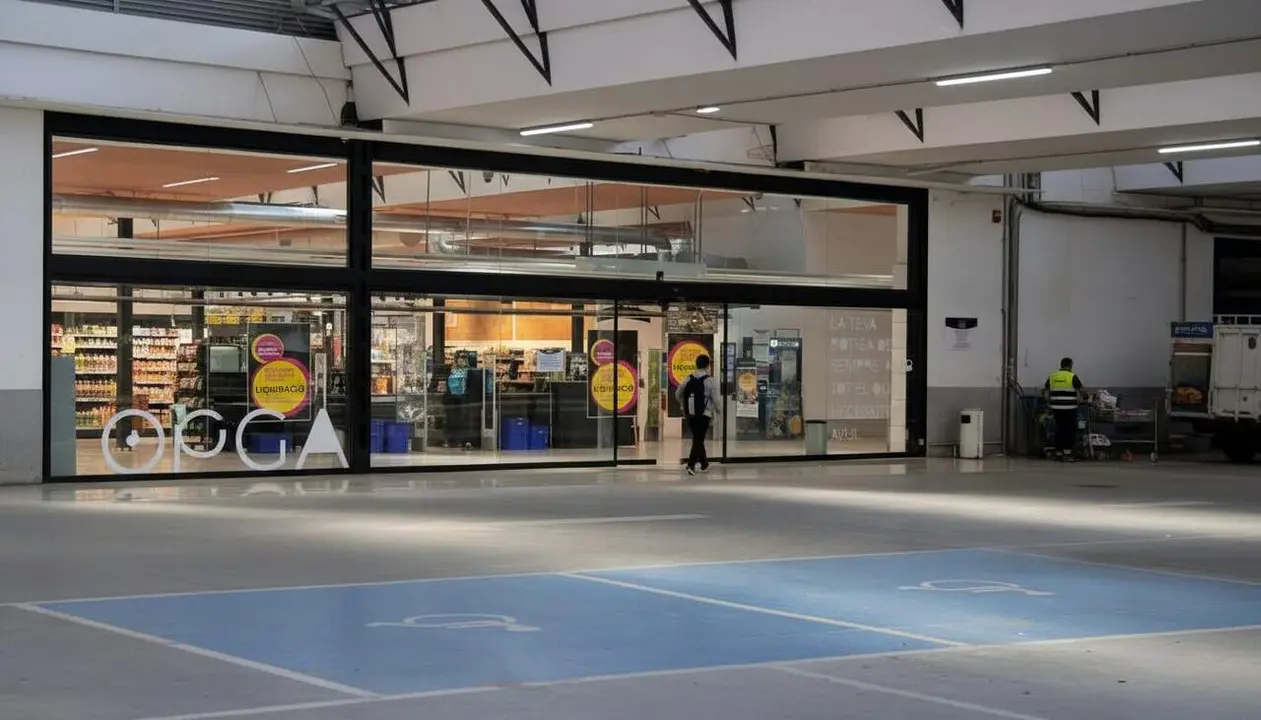

A sign that leaves no room for doubt shakes the clientele of the Eixample: "only in this store, clearance for closing". Suddenly, a supermarket that has been a reference for years disappears without much noise.
The neighbors who passed by the Caprabo on Barberà Avenue every day have already realized it won’t be for long. The empty shelves and growing silence announce that goodbye is imminent. But, what is really happening?
The Caprabo on Barberà Avenue closes its doors
The well-known Caprabo supermarket located between Calders and Martí l’Humà streets, in the Eixample of Sabadell, is in full definitive liquidation. The establishment, which has been a meeting point for many neighbors for decades, has started removing products and reducing commercial activity.
According to own sources and the same sign displayed, the closing will take place when all stock runs out. A move that leaves many with a bitter taste, since this supermarket not only served the neighborhood people but also attracted customers from all over thanks to easy access and large parking.
A place with history and architectural value
Caprabo is part of the Molins Germans factory complex, also known as Cal Molins, a space with architectural protection. The building where the establishment is located was built in the 1940s by Santiago Casulleras, a rationalist architect who also designed Artextil.
Despite the protection of the factories, the supermarket section is privately owned, and for now the future uses of the space are unknown. Neighbors watch with curiosity and some concern what will come next.
Caprabo bets on other areas of Sabadell
While the Caprabo on Barberà Avenue closes, the company has recently opened a new store on Mestre Square, in the Gràcia neighborhood. It also maintains supermarkets on La Rambla and on Sol i Padrís Street, areas that have gained commercial prominence in the city.
This move seems more than just a simple temporary closure: a territorial reorganization strategy that leaves behind one of the most emblematic points of the Eixample.
Impact on neighbors and nearby businesses
The void left by one of the reference supermarkets
The Caprabo on the avenue has been for years a daily meeting place for many neighbors, who regret that now they will have to look for less convenient or further alternatives. The loss of a supermarket with parking and good accessibility does not go unnoticed.
Some residents comment that, despite the proximity of other supermarkets, no one expected this closure to be so imminent. The feeling is that the neighborhood loses a bit more of its commercial nerve center.
Local businesses and growing competition
The disappearance of Caprabo also reshapes the commercial map of the area. Small shops see an opportunity but know that competing with big brands is not easy. The uncertainty about the future use of the building also generates expectation among merchants and neighbors.
One of the regular voices in the neighborhood says: "If they open another supermarket, let it be with the same ease of access and parking, because that is much needed here."
Alternatives and new horizons for the neighborhood
Proximity competition renews the area
With the recent opening of a Caprabo on Mestre Square and the presence of other establishments on La Rambla and Sol i Padrís, the chain does not disappear completely from Sabadell. Neighbors will have to change habits and get used to new routes for shopping.
Moreover, the disappearance of Caprabo on Barberà Avenue could open the door to new commercial or residential projects in the space, although for now everything is speculation.
The future of Cal Molins, pending
The Cal Molins complex, with its protected factories, is a key element of the local architectural heritage. The part occupied by the supermarket is private, and no definitive plan has been made public. Neighbors and city entities hope that any change respects the essence of the space.
Until then, the liquidation of Caprabo leaves a city with an empty emblematic space and clientele awaiting news.
In this context, many remember other emblematic closures, such as Roser closes after 45 years in Reus, which also impacted the local community.
Meanwhile, the city’s economic movements do not stop. Recently Amposta closed the 2025 budget with a positive balance and controlled debt, but the reality of local commerce forces rapid adaptation.
The reality is that the Caprabo on Barberà Avenue disappears from a neighborhood that will now have to reinvent itself to fill this void.