Catalonia prepares for the century’s total solar eclipse: 50,000 people expected in Camp and Ebre
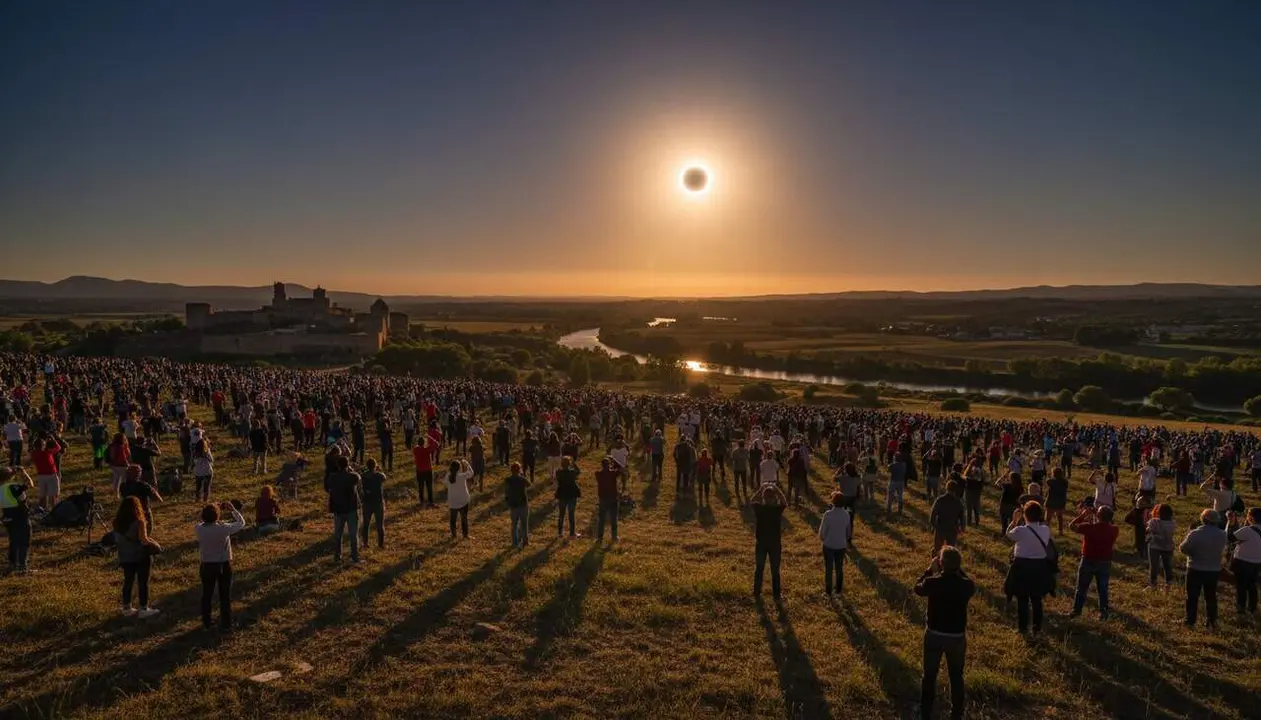

The total solar eclipse of the century will be visible this Wednesday, August 12, in Catalonia, a phenomenon that will not be repeated for another 154 years. The municipalities of Ponent, Camp de Tarragona, and Terres de l’Ebre are preparing an exceptional deployment to welcome thousands of visitors and ensure the safety of observation areas.
The mobilization exceeds 700 officers and extraordinary measures are being implemented to prevent incidents, while the Government will distribute 150,000 certified glasses to protect the visual health of observers.
Security and mobility arrangement for a unique phenomenon
What does the presence of 700 police officers mean for residents and visitors?
The police deployment is one of the key aspects of this day. With 700 personnel, including 180 specialized in traffic, the Mossos d’Esquadra will closely monitor the AP-7 and A-2, the main access roads to observation points. The goal is to avoid traffic jams and guarantee smooth circulation, especially with restrictions on heavy vehicles during the afternoon and evening.
What restrictions and preventive measures have been activated?
To prevent overcrowding and fire risks, motorized access to the Ports and Montsant natural parks has been prohibited from Tuesday evening until Thursday morning, with exceptions for residents. In addition, localities such as Vandellòs and l’Hospitalet de l’Infant have closed paths and roads to control attendance. The reinforcement of the 112 emergency number and the Rural Agents with 150 personnel ensures a rapid and controlled response.
Tourism and accommodation booking: a surge in the southern half
Why are reservations skyrocketing in Lleida, Tarragona, and l’Ebre?
The astronomical phenomenon has caused a spectacular increase in hotel and restaurant bookings, with prices multiplied by four or five in Lleida, where August is usually low season. The estimated economic impact in the State is 347.6 million euros, with more than 50,000 people expected at the 23 official observation points in 18 municipalities.
How are the municipalities organizing to accommodate this wave of visitors?
Small municipalities such as Santa Bàrbara (4,500 expected visitors, more than its population) and Valls (observation point for 5,000 people) have arranged spaces and parking lots and are preparing access closures to avoid collapses. Montbrió del Camp has created a rustic space with capacity for 2,500 people and 650 parking spaces, with plans to close access in case of saturation.
Recommendations and scientific studies about the eclipse
What precautions should observers follow?
The use of certified glasses according to ISO 12312-2 standard is essential to avoid severe and irreversible eye injuries. The Department of Health insists on not using conventional sunglasses or homemade methods, and glasses may only be removed during the minute of totality in areas with 100% coverage.
How is the eclipse being used for scientific research?
The Meteorological Service of Catalonia is deploying equipment to study atmospheric effects, with the launch of three weather balloons from the Ebre Observatory before, during, and after totality. Meanwhile, in Barcelona, automatic radiosonde monitoring will be conducted to compare data and analyze the atmosphere’s response to the sudden decrease in solar radiation.
The Ebre Observatory will broadcast the eclipse live over the internet and is organizing educational activities to bring this historic event closer to the public.
Source of the article: Aina Martí / Catalan News Agency