Price of milk at Mercadona, Carrefour, and other supermarkets in 2026
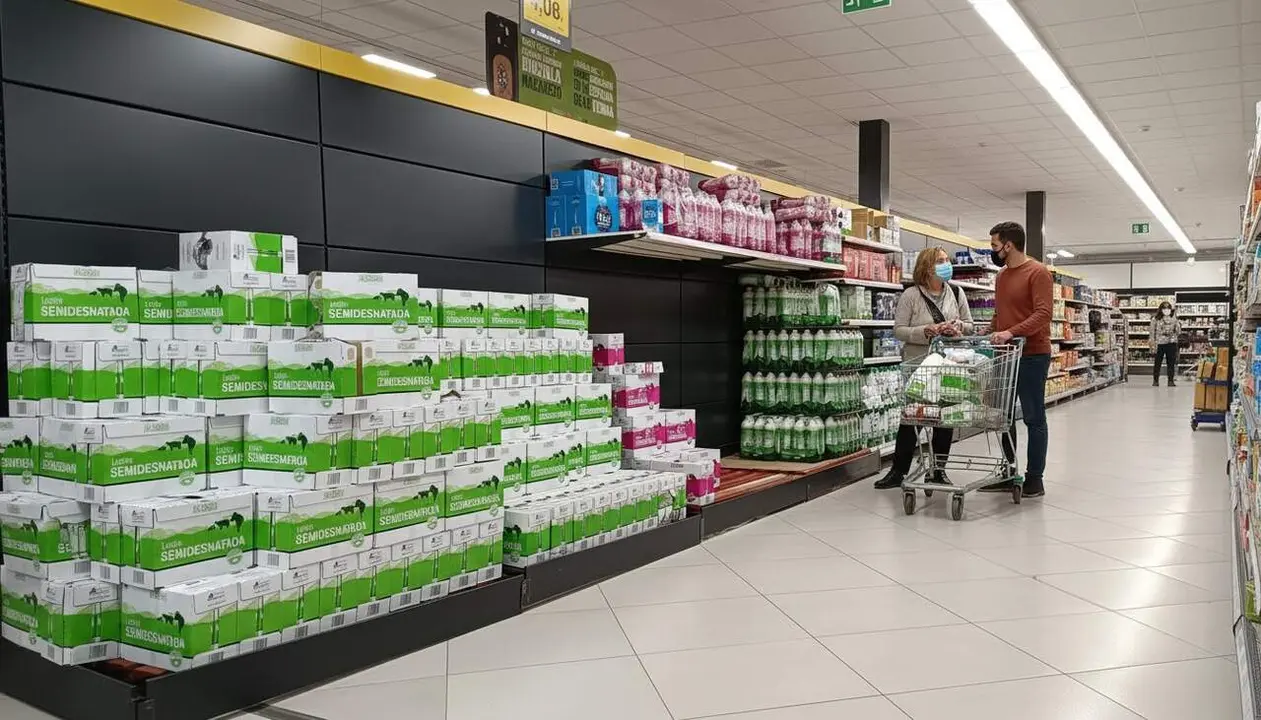

Supermarket shelves have never been as closely watched as they are now, when looking for the cheapest option for milk has become a strategic exercise. With inflation still present, many consumers scrutinize this basic product while chains play a price game that seems endless.
But the reality is that, in this battlefield, not all private labels are equal. The price difference between Mercadona and Hipercor may surprise more than one, and the variety of available milks seems to have its own complex and changing ecosystem.
The price of milk at Mercadona, Carrefour, and other supermarkets
💶 Milk prices (1 liter): between €0.82 and €1.35 depending on type
🕐 Date of analysis: April 27, 2026
🍽️ Milk types: whole, skimmed, lactose-free, with calcium
Comparison of the most recent prices
Private labels maintain their position as the most affordable option. For example, whole milk ranges from €0.94 at Carrefour to €1.14 at Hipercor. Skimmed milk moves within a range of €0.82 to €1.09, while lactose-free and calcium-enriched versions reach higher prices, up to €1.28 and €1.35 respectively.
At Mercadona, whole milk is found at €0.96 and skimmed at €0.82, positioning itself as one of the most competitive options in the market. In contrast, Hipercor leads the high-price zone, especially with its calcium-enriched milk at €1.35 per liter.
Price table by supermarket (own brands, April 27, 2026)
| Supermarket | Whole | Skimmed | Lactose-free | With calcium |
|---|---|---|---|---|
| Carrefour | €0.94 | €0.82 | €0.91 | €1.05 |
| Alcampo | €0.96 | €0.82 | €0.91 | €1.05 |
| Mercadona | €0.96 | €0.82 | €0.94 | €1.17 |
| Dia | €0.97 | €0.84 | €1.04 | €1.10 |
| Consum | €0.96 | €0.82 | €0.94 | €1.17 |
| Eroski | €0.96 | €0.82 | €0.91 | €1.15 |
| Hipercor | €1.14 | €1.09 | €1.28 | €1.35 |
Factors influencing the price of milk and the dairy sector
Price stabilization and abundant supply
After a period of historic inflation, the dairy market is adjusting. According to Rabobank reports, global production grew by 2.2% year-on-year in 2025, generating an excess supply that pressures prices at origin, especially for butters and powdered milks. This abundance keeps consumer prices more stable, especially in private labels, where competition between chains is more visible.
But not everything is simple: the strength of the euro and tariffs imposed by the USA and China hinder exports, complicating absorption of accumulated stocks and maintaining pressure on prices.
Changes in consumption and trends in the Spanish market
The Spanish Ministry of Agriculture indicates a slight decrease in liquid milk consumption, while interest grows for value-added dairy products, such as cheeses or fermented milks. This trend is related to loss of purchasing power and a more selective attitude among consumers, who seek to balance quality and price in a complex economic context.
Cattle farmers in Cantabria have demanded that the industry review prices, although the industry bets on sustainability and innovation to maintain sector balance in the long term.
Value-added tax and outlook for 2026
VAT on basic products
Milk is considered an essential food and is taxed with a reduced VAT of 4%. It should be remembered that during the price crisis between 2022 and 2024, this tax was temporarily lowered to 0% to contain the cost of the shopping basket. Now, in 2026, although there are proposals to reduce it again, 4% is the general current rate.
Forecast for the rest of the year
Rabobank expects that the recovery of prices to historic levels will consolidate at the end of 2026, once the market has absorbed current inventories. The National Federation of Dairy Industries (FeNIL) highlights that differentiation and innovation will be key to maintaining competitiveness, always adapting to the market’s real capacity and the consumers’ economic situation.
In this context, consumers can compare in detail the price at Mercadona, where the competition to offer the best value for money is more evident than ever.
Private label milk prices are the best reference for making an intelligent purchase, as manufacturer brands like Puleva or Asturiana tend to maintain higher prices due to their investment in marketing and positioning.
The reality is that, despite fluctuations, milk remains an essential product that conditions a large part of the shopping basket and, therefore, deserves detailed attention when deciding where to buy.