
The LightGen revolution: 100 times more powerful than Nvidia A100
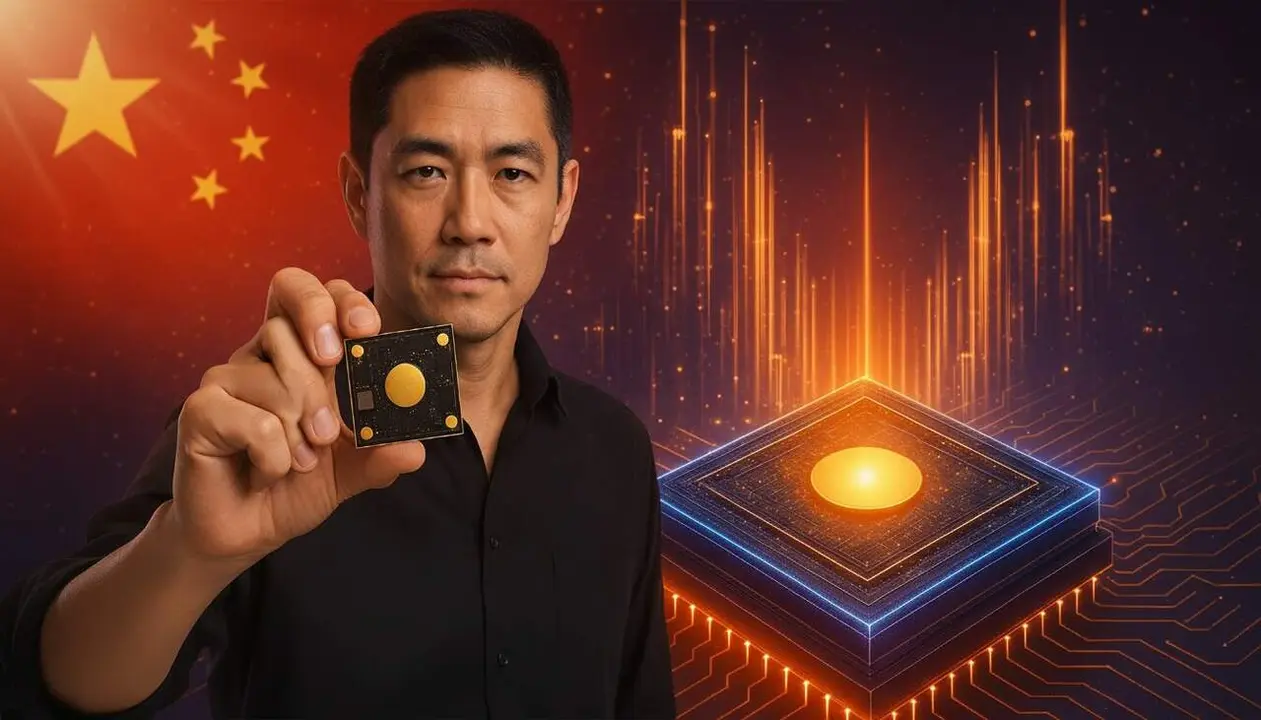

Imagine a processor capable of processing data at the speed of light and with power exceeding the Nvidia A100 GPU by more than 100 times. LightGen is not science fiction but a photonic prototype developed in China that promises to revolutionize artificial intelligence.
The project, led by Jiao Tong and Tsinghua universities, aims to replace traditional cables and transistors with optical neurons that manipulate light, eliminating heat and multiplying computing capacity. Want to know why it is so special? Keep reading.
The LightGen photonic processor: a Chinese technological leap
Origin and goal of LightGen
LightGen is the result of a collaboration between Shanghai Jiao Tong University and Tsinghua University. It is not a commercial product but an advanced prototype aimed at accelerating generative artificial intelligence models, especially in tasks of image, video, and 3D scene creation.
Its operation is based on replacing electronic transistors with "photonic neurons" that process light pulses, maximizing speed and minimizing thermal dissipation, a crucial advantage when the volume of data is enormous.
How LightGen's optical computing works
The chip uses light pulses that circulate through its structure, where each optical neuron manipulates the intensity and phase of light to perform complex operations. This system avoids the usual electrical friction, allowing much faster processes with lower energy consumption.
Thanks to its 3D architecture, it integrates more than two million neurons in a small space, a scale that enables high-resolution video generation and 3D models without the need for massive GPU farms.
The advantage of optical neurons and the optical latent space
Density and integration capacity
What differentiates LightGen is its high neuronal density: more than two million photonic neurons packed in just a quarter of a square inch. This far exceeds previous prototypes, which were limited to a few thousand neurons and only performed simple tasks.
This great integration allows tackling complex generative models, such as 3D manipulation and video generation, which previously could only be done in centers with many traditional GPUs.
Optical latent space and data compression
LightGen introduces the concept of optical latent space, where the compressed representation of information is manipulated directly with light. This innovation is based on the use of ultra-thin metasurfaces and fiber arrays that allow processing multidimensional data without fragmenting it into blocks, better preserving the original information.
This reduces the number of steps needed to generate images or other content, improving the quality and efficiency of the generative process.
Limitations and future of photonic computing
Current challenges of LightGen
Despite its advantages, LightGen is still experimental and presents significant challenges. The system depends on external lasers to generate the optical signals, which complicates its assembly and increases costs.
Moreover, chip fabrication requires specialized processes not integrated into the current semiconductor industry, making large-scale production difficult.
Potential impact on generative artificial intelligence
If these barriers are overcome, LightGen could significantly reduce the energy consumption of data centers running generative AI models, making the technology more sustainable and accessible.
It also opens the door to hybrid systems where electronic and photonic processors work together, leveraging the best of each technology for specific phases of processing.
| Feature | LightGen | Nvidia A100 |
|---|---|---|
| Processor type | Photonic (light) | Electronic (transistors) |
| Integrated neurons | More than 2 million | Hundreds of thousands |
| Relative power | 100 times higher | Baseline comparison |
| Energy consumption | Much lower | High |
| Main application | Advanced generative AI | General AI and computing |
The reality is that LightGen marks a before and after in the way we understand information processing for AI. We may not yet see it in our computers, but the future of photonic computing has begun to be written in China.