Germany successfully validates electric trucks that charge on the move
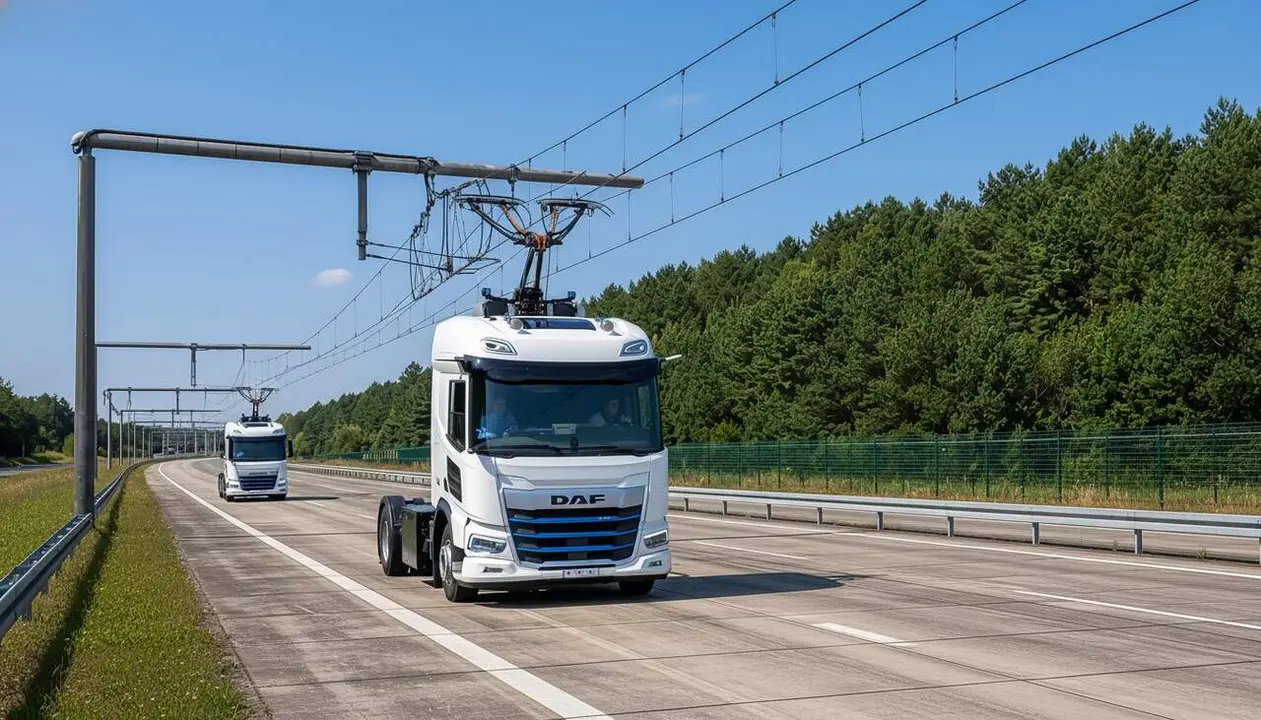

Imagine two trucks driving on the highway not only silently but recharging as they move forward. No, this is not the plot of a science fiction movie, but a reality gaining momentum in Germany.
With an investment of nearly 5.9 million euros and more than 10,000 km traveled, these DAF trucks not only challenge the tradition of heavy diesel transport but also put to the test a technology that promises to break new ground.
Germany and the revolution of electric trucks with dynamic charging
The “BEV Goes eHighway – BEE” project, completed by RWTH Aachen University, has been a clear bet to validate dynamic charging via catenary as a solution for long distances in heavy transport.
To do this, two DAF XD Electric trucks, called “Maja” and “Willi,” integrated a system that allows connecting a pantograph to overhead electric cables while driving. Thus, these vehicles can recharge on the move without the need to stop, an idea reminiscent of old trolleybuses but adapted to the size and demands of modern transport.
Operation and certification of the prototypes
The prototypes underwent a certification process allowing them to drive on German public roads. During the tests, which began in 2022 and extended until the end of 2025, they traveled three real electrified corridors: ELISA in Hesse, FESH in Schleswig-Holstein, and eWayBW in Baden-Württemberg.
When the truck leaves the electrified lane or catenary zone, the pantograph automatically folds, and the vehicle continues operating with the energy stored in the battery, which can also be recharged in just 8 minutes at stationary points.
Impact on batteries and total cost
One of the key points of the project was analyzing how this technology can reduce the need to use large-capacity batteries, which are expensive and heavy, as well as the effect of dynamic charging on their degradation. Studies suggest that with this solution, the total cost of ownership for truck fleets could be reduced.
The reduction of downtime for charging and the possibility to cover more kilometers without losing time makes this technology particularly attractive for long routes, the great challenge of heavy electric transport.
The future of decarbonization in freight transport
The project leaders consider that charging on the move could be a pillar for sector decarbonization, although its implementation depends on the creation of a sufficiently extensive catenary infrastructure network.
Roger Alm, president of Volvo Trucks, states clearly: "It has never been easier to replace diesel trucks with electric ones." This is a statement that challenges the traditional view of heavy transport.
Limitations and pending challenges
It is clear that this solution will not work without a massive deployment of electrified points along the busiest routes. This requires a significant public and private investment and an agreement among different sector players.
However, the advantage of being able to reduce battery size and avoid constant charging stops opens a door to efficiency that no other technology has achieved so far.
Comparison with other alternatives
Other electric trucks on the market depend almost exclusively on limited range and stationary charging, which entail downtime and tight planning. In contrast, this technology allows electric trucks to resemble their diesel counterparts more closely in terms of operability and flexibility.
The system is similar to the known trolleybuses but applied to heavy vehicles on modern highways, giving it a futuristic yet practical edge.
Future-proof DAF trucks
The DAF XD Electric trucks featured in the test are a clear example of how these innovations can be transferred from the lab to the real road. With a range of over 600 km and the possibility to recharge in just 8 minutes, they present themselves as a real alternative for the industry.
The support of the German Federal Ministry for the Environment and collaboration between universities and industry are the driving force behind this silent but unstoppable revolution.
Key technical details
| Feature | Detail |
|---|---|
| Model | DAF XD Electric “Maja” and “Willi” |
| Test route | More than 10,000 km |
| Total investment | €5,900,000 |
| Range | 605 km (with dynamic charging) |
| Static recharge time | 8 minutes |
Benefits for fleets
- Reduction of battery size
- Less downtime for charging
- Improvement in total cost of ownership
- Reduction of emissions and noise
Finally, this test in Germany not only confirms that charging on the move is viable, but also paves the way for more countries and manufacturers to consider this technology as a key piece for sustainable mobility in heavy transport.
The reality is that, as infrastructure progresses, seeing electric trucks charging on the move will cease to be a curiosity and become the norm.