Alicante experts agree: seafood rice is the king
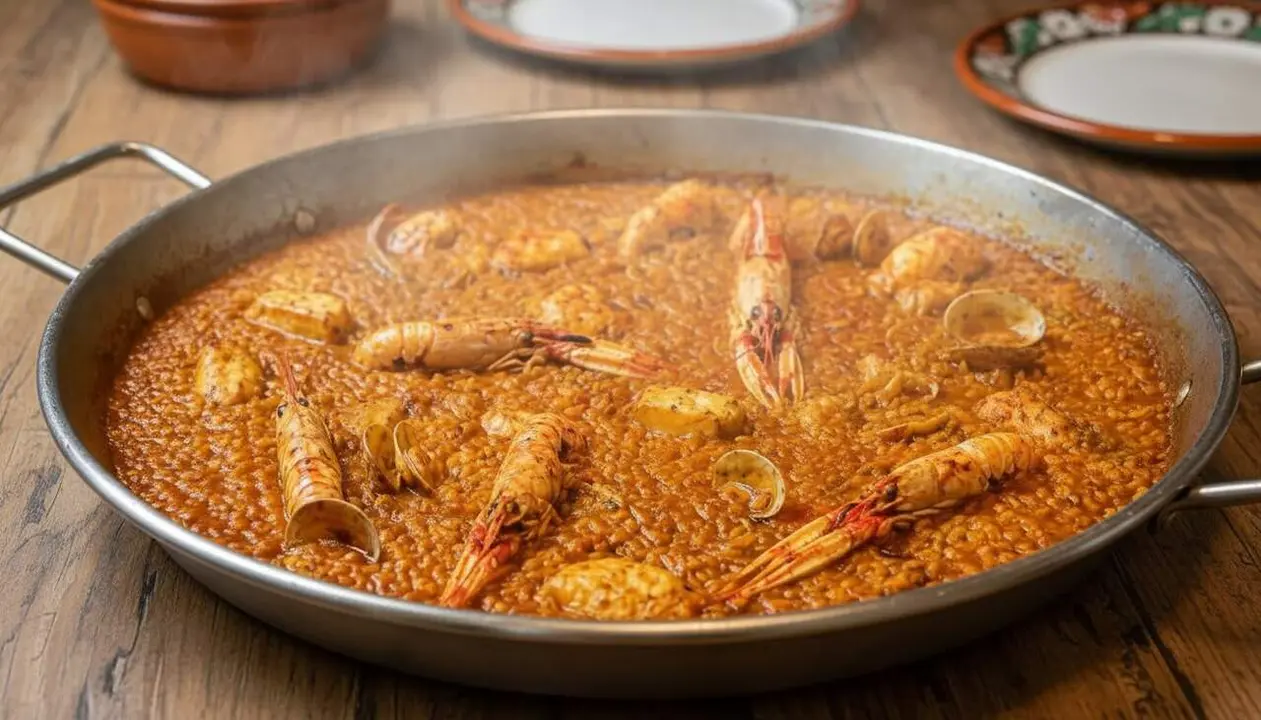

Right on the Alicante coast, any conversation about cuisine inevitably ends up talking about rice dishes. But it’s not just any rice: arrossó a la marinera steals all the attention, with a fish stock that leaves no doubt and slipper lobsters that seem to have a personality of their own.
Local specialists do not only agree on the quality of the product but also on the technique: the fish stock, the essential base, must be powerful, and the cooking process requires a balance that not everyone masters.
The fish stock, the soul of arrossó a la marinera
⏱️ Cooking time: 25 minutes
🔥 Calories: approx. 450 per serving
👨🍳 Difficulty: medium
The key to the fish stock
Alicante experts agree that the fish stock is the foundation of the dish. Made with small fish, tomato, garlic, and the typical ñora pepper, the broth achieves an intense flavor that permeates the rice from the very first moment. This base is not a simple accompaniment but the calling card that sets it apart from other rice dishes on the Valencian coast.
According to recent statements, “without a powerful and well-balanced fish stock, any rice dish loses its maritime essence,” explain chefs from a traditional Alicante kitchen.
The prominence of fresh products
The dish is not limited to a static formula. The slipper lobsters, shrimp, and clams are the stars that bring texture and flavor, but careful control of the heat and timing is necessary to maintain freshness. Fish such as monkfish and tuna are sautéed beforehand to create a layer of flavor that then combines with the fish stock.
The result is a rice dish that maintains its personality in every spoonful.
Alicante, the gastronomic capital of arrossó
A city that speaks rice
The Alicante City Council promotes the initiative ‘Alicante Ciudad del Arroz’, which aims to highlight this culinary tradition and make it a global reference. The local gastronomy revolves around this ingredient, which transforms into multiple versions depending on the season and availability of fresh products.
Experts emphasize that one could taste different specialties every day of the year, showcasing a repertoire ranging from dry rice dishes to creamy or soupy ones, always based on local products and inherited techniques.
Traditional recipe with modern touches
Making arrossó a la marinera is an exercise in balance and respect. First, pieces of monkfish, tuna, shrimp, and slipper lobsters are sautéed and then set aside. Next, the fish stock is added along with the clams and finally the rice, controlling the heat to achieve the perfect doneness.
This technique stays alive and has been defended by local cooks who remind that patience and precision are key to succeeding in this iconic dish.
Technique and ingredients: step by step of arrossó a la marinera
The basic ingredients
- 400 g of rice
- 550 g of monkfish
- 550 g of tuna
- 150 g of peeled red shrimp tails
- 100 g of clams
- 200 ml of oil
- 8 slipper lobsters
- 1200 ml of fish stock
Detailed process
| Step | Instruction |
|---|---|
| Step 1 | Heat the oil in a large pan. Sauté the monkfish, tuna, shrimp, and slipper lobsters until well browned. Set the slipper lobsters aside for later. |
| Step 2 | Add the hot fish stock and clams. Let it boil for about five minutes so the flavors integrate. |
| Step 3 | Add the rice evenly. Cook over high heat for eight minutes. |
| Step 4 | Place the slipper lobsters on the rice. Reduce the heat and cook for about ten more minutes over low heat. |
| Step 5 | Remove the pan from the heat and let rest for five minutes. This way, the rice finishes cooking and reaches the perfect point. |
The result is a dish that, as Alicante experts explain, does not tolerate shortcuts. The fish stock does all the work, and only first-quality products like the slipper lobsters can round out the experience.
Finally, it is worth listening to the experts who recommend never losing sight of freshness or technique, because only this way is the tradition and authentic flavor of arrossó a la marinera preserved.
The reality is that this dish is the perfect expression of a coastline that knows how to combine sea and land, tradition and innovation, in every grain of rice served at the table.